
True or False? Is Foot Pain the Cause of Hoof Pain?
Hello Everyone!
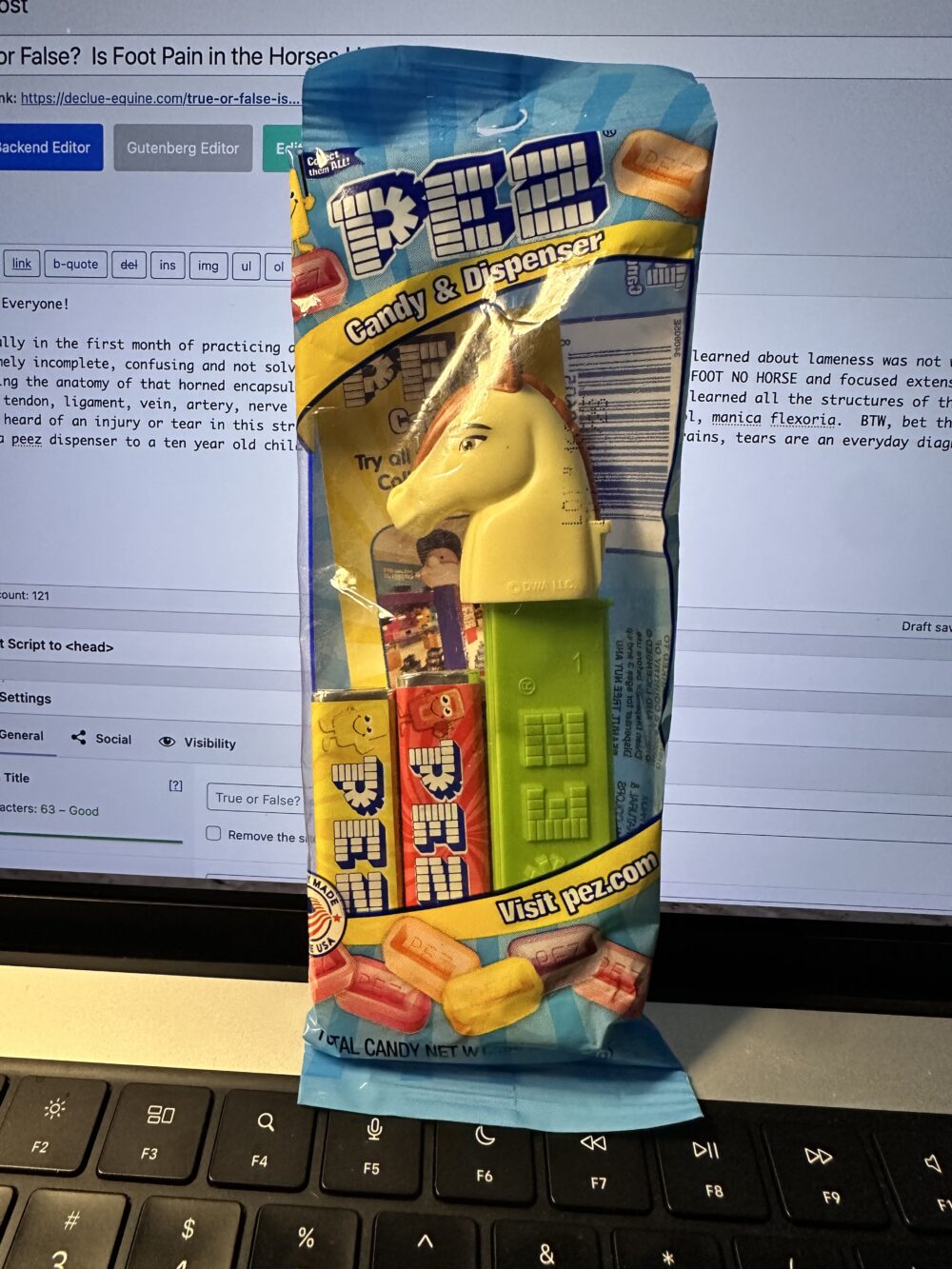
Literally in the first months of practicing as an equine veterinarian, I realized that what I learned about lameness was not wrong but extremely incomplete, confusing, and not solving problems seen in my patients. We learned NO FOOT, NO HORSE and focused extensively on learning the anatomy of that horned, encapsulated structure called the HOOF. We meticulously learned all the structures of the lower limb, every tendon, ligament, vein, artery, and nerve, and my favorite structures: the annular ligament and manica flexoria. Have you ever heard of an injury or tear in these structures before? Maybe? It is highly unlikely. Instead, I bet that you know what the dreaded proximal (origin) suspensory ligament is. Proximal suspensory injuries, strains, and tears are everyday diagnoses given out like a PEZ dispenser to a ten-year-old child. And yes, of course I have a horse PEZ dispenser.
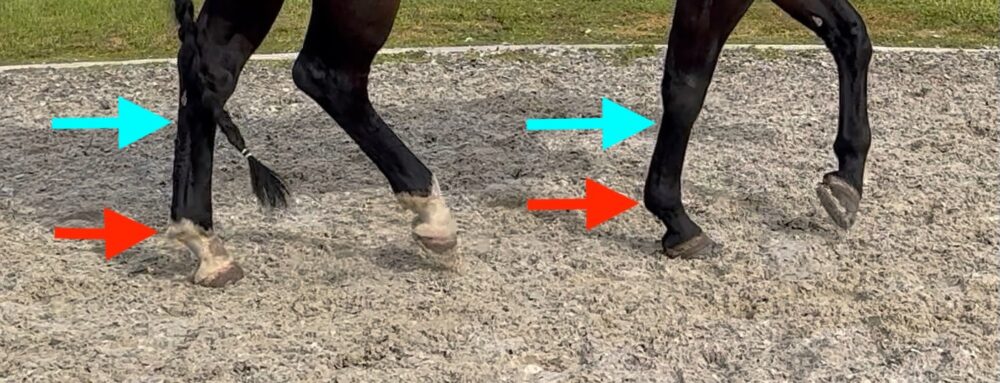
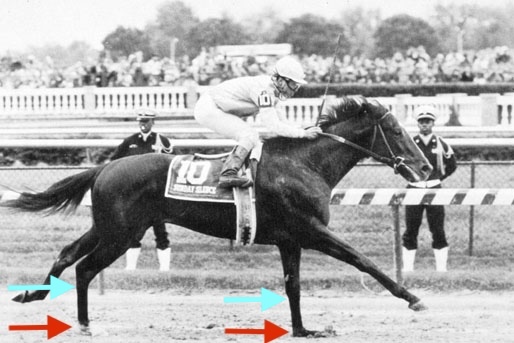
There should be just as many annular ligament lesions diagnosed as there are suspensory lesions because they BOTH are support structures that prevent hyperextension, i.e., dropping, of the fetlock joint on every single stride the horse takes. Confusing? Clear as mud? Exactly my point. However, structurally, it makes sense if one knows biomechanics or just simple pulley systems. The red arrows point to the annular ligament, and the light blue points to the proximal suspensory ligament. Form your own opinion.
When one realizes that what you actually thought you knew is wrong and/or incomplete, it leads a person down three distinct decisions, like coming to a Y in a road.
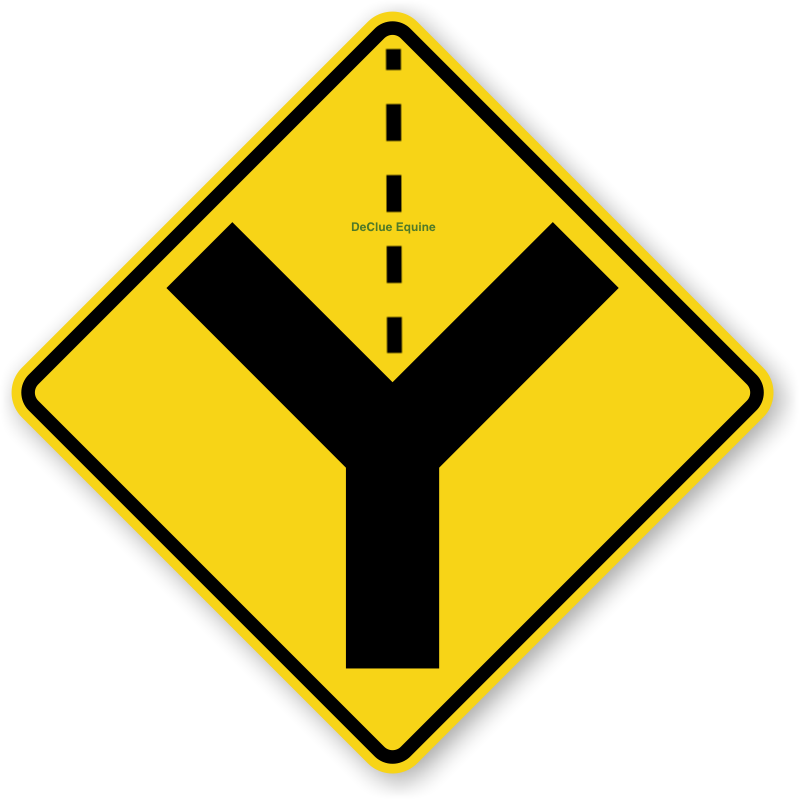
1. Right: Keep accepting, holding on to, and doing what you know currently and were taught. The horse is still lame. 2. Left: Treat something else you “think” “may be” the problem. The horse is still lame. 3. Continue straight and form your own way and lane that gets results. It means looking at and thinking for yourself and having curiosity about WHY. You also have to accept that you are the common denominator to this problem, so find the solution.
Just like a “Y” intersection, one has to have the curiosity to ask, “WHY?” WHY is the horse still lame? WHY is the owner complaining that the horse is not better and feels the same? WHY, after 9 months off for a suspensory lesion, is the horse still lame? WHY, Y, WHY, Y, WHY! Same thing but different spelling for a word, letter, or symbol for CURIOSITY! It is the annoying child responding “WHY” to everything you say. As a child, and still as an adult, I have never stopped asking the question of WHY. It is WHY I am different as a veterinarian and one of many reasons WHY I do not “fit” into the culture of the veterinary profession. And most importantly, I am cool with that fact.
Curiosity is asking questions. When you start asking more questions than you have answers to for a continued problem, then that is when REAL LEARNING starts. It is always asking another question. If the horse is still lame, WHY? WHAT am I missing? HOW does this structure actually work with the other structures of the body? What is the trainer describing the horse is doing or feeling like at a certain moment? WHEN does the trainer feel it? WHEN does the horse react? WHAT causes the clinical signs? WHY, WHAT, WHEN, WHERE, and HOW. These are the fundamental, open-ended words to question and to help gather complete information, solve problems, or analyze data and hypotheses.
Back to the original question of this blog. Is the foot pain in the horse’s hoof? True or False? Answer: True! 100% TRUE!
If you got this correct, please comment on this blog and tell me your thought process! I love to know how people think!
What are the questions to ask to confirm this statement or hypothesis is factual? This is how veterinarians are taught to approach this problem.
Veterinarians’ Questions and Answers to Questions:
Is it something in the actual foot causing pain, like an abscess, hot nail, thrush, or heel bruise? NO to all.
Is there a pulse? NO.
Is the horse positive to hoof testers? NO.
Does the horse block out to the foot? NO.
Are there changes in angle or imbalances the farrier needs to change? NO.
Are there soft tissue changes, swelling, heat, or pain on palpation anywhere in the lower limb? NO.
Are there any ultrasound changes in the horse’s lower limb or foot? NO.
Question: OK, so where do we go from here?
Answer: Let’s start flexing and blocking…all the way up to the proximal suspensory.
Frustration: Now the horse is lame on the opposite front limb and diagonal hind limb.
Question: Keep blocking, right? Opposite limb that is now lame? Hind limb that is now lame?
Answer: WRONG! 100% WRONG! However, this is the illogical approach to how veterinarians are trained to do what they do day in and day out!
Comment: I am sure that if you are a veterinarian reading this and you felt that twinge of defensive thinking, “What facts do you have to say it is illogical?” or “Bullshit.” It’s ok, I understand that there is opposition to learning something that is different from what you once learned as the “gold standard approach” to lameness. The AAEP lameness scale of 1 to 5, may help in some head-bobbing lameness cases of one front limb, but what about head-hopping lameness of a front limb? Please, stuff those emotions down, because they will not help you resolve these problems for your patients, whom I know you truly care about and want to fix. I am here to help you and everyone else.
Question: WHERE do I go from here?
Answer: Ask another question.
Question: HOW do I solve this problem?
Answer: Correct question. You have to accept the simple fact that YOU WILL NOT, NOR ARE YOU, solve the problem by continued blocking of the horse.
Question? HOW can you state this as a fact?
Answer: Because, the fact is, as soon as the horse becomes lame on another limb, no matter what limb, THERE IS COMPENSATORY LAMENESS!
This is where real learning starts…
Question: WHAT is Compensatory Lameness?
Answer: Lameness that is coming from somewhere else to balance out or counterbalance normal biomechanical movement.
Question: WHY does compensatory lameness matter for solving the question?
Answer: Because it means that IT IS COMING FROM SOMEPLACE ELSE! It is NOT PRIMARY LAMENESS IN THE FOOT! Foot lameness is not complicated most of the time, with exceptions to those waxing and waning abscesses hidden somewhere. 98% of the time it is simple to diagnose. It is simple to treat and fix. It is simple. An example of primary foot pain that lasts for weeks is wearing high-heeled shoes to a friends’ wedding. And the fact that the last time you wore those high-heeled shoes was the last wedding you went to, three years ago! High-heeled shoes, weddings, and thoughts of never wearing those shoes again, or at least taking them off for dancing, are primary causes of foot pain!
Compensatory lameness is not simple; it is complex and multifactorial. Meaning…many, many, many factors to take into consideration and how it all works together to solve a problem. It is also a process of elimination, as was shown above, to rule out if the problem was in the foot. However, with compensatory lameness, it takes a deep understanding of HOW the entire structural system and ALL the variables that have an effect on and affect this system to find a common denominator and, most importantly, pattern recognition. Just because the horse has foot pain and lameness of that foot does not mean that it originates from that foot! It means that HOW the limb is moving and landing is important to understand WHAT is causing FOOT/HOOF pain. It is recognizing and understanding non-movement and movement patterns of the horse, which are learned by observation, your eyes, and then by asking the questions of what you see.
Question: Why did I go down this path, actually the dotted path straight off into nowhere of the Y intersection?
Answer: Because I am teaching you how to think and how to approach problems and performance issues that the equine veterinary profession has not resolved in centuries. If I teach you, you teach another and another. I have a blue-collar worker mind, not a veterinarian’s mind, on how I approach problems. I am and have been a journeyman lineman, a control room operator in a distillation plant, a meter reader, a technician in a power plant, and an athlete. These jobs taught me how to think, have extreme grit physically and mentally, and solve problems.
The horse in this video has had LF intermittent and, at times, consistent lameness that no one could resolve or solve. Let’s just say, the foot and limb have been flexed and blocked plenty of times along with shoeing changes, with no resolution of clinical signs. No one looked where I did; thus, the problem was not resolved and lameness and compensatory lameness continued.
Watch your horse, ask questions and you will start recognizing patterns that you did not know were there. Hint: Once you start recognizing a pattern, you will see it in a lot of horses, not only your horse.
That’s all for now. Please comment and share this with all your horse friends, and remember to always put the horse first!
AJD
Love this blog. As a horse owner, I’ve become much more observant of my horse because of your podcast. So happy you started blogging. I don’t have a lot of answers but definitely trying to observe and ask why.
so how can this be helped…. or the horse given relief
2 Comments on True or False? Is Foot Pain the Cause of Hoof Pain?