
Farriers Know Abnormal & Normal: Picking Up a Horses Limbs
Hello Everyone,
It is simple, suppose to be simple, picking up your personal horse or any horses front or hind limbs. It is something that horses are trained to do from the first time they are trimmed at a very young age and thereafter for their entire lives. I work and live in the sport horse industry. The horses that are within this industry are trained to be trimmed and shod by farriers no matter the discipline. It is a simple concept to me, a horse picks up whatever limb you are asking it to pick up when you ask.
A horse, any size should lift the foot easily and smoothly (not snappy, forward, backward, protective) off the ground, as the limb should fold easily, and be held easily for extended periods of time while not losing their balance. They should not lose their balance because they have 3 other limbs to take the counter weight and to provide counter balance. When you release the foot and limb, it should NOT drop to the ground immediately as the muscles, NOT tendons and ligaments which do not have contractile properties. Muscles should contract-relax to smoothly coordinate the placement of the foot on the ground sole side down gently. Any tail swish, ear pinning, turning to look at or bite you, resistance, moving away, picking up the opposing limb instead of the limb you are asking for is ALL ABNORMAL and clinical signs of pain! This simple “asking” relationship sometimes verbally, sometime non-verbally, between human and horse has been occurring for centuries in all languages, as the process has been universal. It is not some new fad created by the sport horse world. Centuries, Roman Empire and before, this relationship has been present as 4 feet of the horse have been trimmed and shod by the 2 hands of a farrier/blacksmith.
The actual act of picking up a horses four limbs for you or a farrier, has not been quantified, measured or published in any article or scientific peer-reviewed journal? WHY? Because no one in the equine veterinary profession sees the importance that the actual ACT of picking up a horses limb is a RELEVANT diagnostic verification that something is or can be physically wrong with a horse. Please read that last sentence again because it is extremely important. Ask any farrier as they know when something is wrong. Especially when it is not in the horses foot, but in the horses body. They know! How do they know? Because they are under horse after horse, day after day, picking up and maneuvering the horses limbs to get a job done. They know something is wrong when they struggle with “just the hind limbs” or “just one hind limb” or “just one front limb” or “that one hind limb is shivering.”
What about flexion exams during a PPE or lameness evaluation? Veterinarians do this “procedure” daily to “diagnosis” lameness. The question is: Are veterinarians aware of the weight of the limb, the ability of the horse to hold up or flex the limb comfortably? Farriers are aware of these indicators of discomfort daily. If you are a veterinarian, you have experienced this, but were you aware? Were you AWARE that the RH limb you cannot flex and hold for even 10 seconds before the horse wanted to slam the limb down but the LH you could have held easily for 10 minutes? I know that you are AWARE of these facts as you have experienced this scenario time and time again. HOWEVER, how is it possible that YOU, a veterinarian, will “pass as sound” this exact scenario on a PPE or lameness evaluation as the horse will trot off “sound” after a few strides forward with “no hip hike”. You are using flexions as a “diagnostic tool” however, is your only focus on whether you can hold the limb up flexed without regard to the act of how the horse released the stay apparatus to flex the limb? The problem is not recognizing that HOW the horse picks up its limb, from the very beginning, indicates at that very moment something is not normal. WHY do we use “flexions” as a “diagnostic tool” for lameness as one should be aware that the practice of “flexing a horse” is a “diagnostic multi-tool” that starts from the moment you ask the horse to pick up its limb. NOT from the moment the limb is in full flexion, held for however many seconds/minutes then dropped/released, as you watch the horse trot off. In my opinion, this unconscious awareness is a systemic problem that is taught in veterinary teaching institutions. I personally know this as a fact, as I was taught the same unconscious awareness throughout my years in veterinary school and before that time when I was a veterinary technician at a veterinary large animal hospital.
Here’s another question for veterinarians that has boggled my mind about doing flexion exams? Let’s say a horse has clean radiographs of its stifles, and hocks. If that horse cannot or has difficulty flexing and holding its RH limb up as it is heavy and difficult to flex, how is it even possible that a spur or lesion in the lower hock joint(s) is the problem? These joints DO NOT MOVE, their purpose is to off load and absorb concussive forces as the bones are mortared and stacked like bricks in your house or a wall. Is your brick or concrete block house suppose to move? Only if the foundation is not constructed properly or destabilized by Mother Nature. So how is it logically possible the lower hock joint(s) are the cause or reason for resistance to flexion or the heaviness and the joints that you inject to solve this problem? Remember, the joints of the hocks and stifles are beautiful on radiographs. It reminds me of the equine veterinary professions illogical focus on the “SI” and kissing spine surgery to solve anatomical “lesion(s)” with no regard or fundamental understanding of/to these stabilizing and load bearing structures. No one is questioning or considering other causes for why the horse is unable to hold its limb flexed for more than 10 seconds, as farriers are stuck dealing with the repercussions? Though veterinarians will continue to flex and block horses as a “procedure” that is at times barbaric and archaic as a means to justify their liability of practicing sport medicine.
Are there soft tissue or muscular structures that can cause the horse to not want to stretch or compress by flexing the limb? Absolutely! Calcaneal tendon (achilles tendon in humans) is a prime example. Very common in my patient population depending on the discipline, but not diagnosed often by sports medicine veterinarians, because who knew that horses have calcaneal tendons? Like elbows, scapulas, the nuchal ligament, Iliopsoas muscle, costochondral junctions and lumbosacral-intertransverse joints. Do horses have these structures in their body? Great question with the answer being yes to all!
Ask any farrier where the problem is for heavy legged horses, as there are hundreds of thousands out there! To solve these problems the veterinarians continue to inject the stifles, lower hock joints, and “SI” because why not, they have to do something right? The farriers, month after month have to continue to struggle with, month after month, horses like this due to the lack of curiosity and thought process of an equine veterinary profession that is unwilling to use their education and think for themselves. This IS a criticism. This IS a pattern. If you are a professional, any professional, criticism and listening to new perspectives that may oppose the current “norms” of practice is needed for change. Companies led by CEO’s unwilling to listen to criticism or new perspectives have toppled as academic institutions have lost brilliant talent due to fact that those in power and leadership positions shield themselves or refuse to listen to criticism and new perspectives to solve embedded problems of dysfunction. NASA, Blackberry, Enron, Toys R Us, Lehman Brothers, Wells Fargo Bank are all examples of catastrophic accidents, financial scandals and closures due to leaderships unwillingness to listen to reason from “subordinates”.
Dr. Kerry Ridgeway, a brilliant veterinarian that was always open to learning from anyone, started all of his presentations with this quote:
“Today’s knowledge is tomorrow’s misinformation.”
The practicing equine veterinarian seems to be waiting for some peer-reviewed paper to tell them or give them permission to accept a new model or way to do something. The struggle I have is when those of “higher education and status” defend and support peer-reviewed papers to stay in their placement of “status”, because going against the” status quo” puts them as an outsider to the their own “club” even though they still maintain entry. They, the “higher educated with status” are the “gate-keepers” of knowledge and new perspectives of knowledge reaching the general population of horse owners. I have learned that IF it is not their idea, IT DOES NOT EXIST, until THEY decide that it does. Or until you as readers reading this blog, push for the change that needs to happen by not accepting the current standard of practice being taught by the equine professional institutions.
Elitism, racism, sexism, dogmatism, these “Isms” are all the same “disease” process of an unconsciousness mind in individuals based on their ego’s need for a hierarchical structure of “subordinates” establishing a clear line of authority and status. It is UNSCIENTIFIC to make a decision or have a strong opinion on things that have not been proven by science. Concrete used for our highways and roads is initially a fluid mixture of cement, aggregate and water that over a short period of time becomes a hard surface. Science is not hard and rigid like concrete. Science is curiosity of asking questions while challenging hypotheses and theorems. Many minds in the world of veterinary science were once a fluid mixture of learning and curiosity that became rigid and hard with their own minds position for justification. Just because something does not have a quantifiable number, measurement of size, assay or titer does not mean it does not exist. This mindset does nothing to advance equine science and thus help more sport horses.
A great example of “Ism-Isms” (a new word I just came up with) of the equine profession is a “condition” that farriers are usually first to diagnose, and have the unfortunate consequences of dealing with the difficulty and unpredictability of picking up the limbs of Shivers horses, while maneuvering non-stop to keep themselves safe from injury. The equine “Ism-Isms” club has accepted and continues to promote that the “cause” of why horses have Shivers is a cerebellar “lesion” in the brain therefore there is NO treatment and nothing WE as veterinarians can do. It is based on a peer-reviewed published paper in 2015 doi.org/10.1177/0300985815571668 with FIVE Shivers horses as the patient population with three “normal” horses as controls.
ANY medical doctor, in any field of medicine would conclude that absolutely no factual conclusion can be based on FIVE CASES! Would you want a doctor to do any procedure or conclude a treatment protocol on you or your child based on five experiences? If there were 50 patients, then one can make conclusions and form hypotheses from the patterns recognized and results. But five?
No matter what mammalian species, if there is a degenerative lesion, disease or traumatic injury to the cerebellum the animal/person will exhibit clinical signs of ataxia, hypermetria (uncontrolled jerky movement of the body/limbs) and affects the ENTIRE BODY not just ONE limb! So how can a horse with Shivers only have “shivers” clinical signs in the RH limb or just LH limb or just RF but not LF when any cerebellar lesion affects the entire body? How can a horse with Shivers coordinate to jump and perform coordinated dressage movements if it had a degenerative cerebellar lesion or disease process? Why is it ONLY “when they back up” or “picking up the limb” that you see the clinical signs? How is this thought process at any moment scientific or logical? It is not. It is putting conditions and restrictions on a region of the brain that is responsible for coordinating voluntary movements, maintaining posture, and regulating balance. Any animal or human with a cerebellum problem cannot WILL or TELL their cerebellum to move their body in a coordinated and smooth manner. My best friend from the college, Celeste Zink, lives daily with the repercussions of Machado-Joseph Disease (MJD) a progressive and neurodegenerative disorder of the cerebellum and brainstem. I know as I have witnessed these facts in someone that I love.
If a horse actually had a degenerative “cerebellar” disease or “lesion” it could not walk forward in a coordinated manner nor any means of a straight line, much less back up or walk in a circle. Both backing or circling, would definitely be a hazard to anyone asking the horse do this, if it could, without falling down. Do a “tail pull” test on a hind limb Shivers horse. Veterinarians use the “tail pull” test as a diagnostic tool for ataxia or neurological deficits in horses. It will be normal on Shivers horses as they progress in clinical severity. A person cannot pull a clinically moderate or moderate-severe Shivers horse off balance on the limb with Shivers clinical signs due to the nature of the injury. Try it. Any horse having a cerebellar lesion, or any species with a tail with a cerebellar lesion, would fail this test. Farriers do not need a tail pull test to tell them this fact, as moving a Shivers horse laterally can be nearly impossible at times. They know, ask them, though no one is asking their opinion. What about horses that do not have Shivers but cannot move laterally? Are they similar injuries/problems as Shivers horses? The answer is yes they are similar injury regions but NO it is not a cerebellum problem.
The equine “Ism-Ism” club that is out there defending each other has elected to NOT CARE about any horse with the clinical signs of Shivers! Harsh statement yes, but it is true. Sad as the fact may be, it is heart breaking at times for me as a person and veterinarian who truly loves horses. If they did care about horses ABOVE their ego, educational status, and club membership horses with Shivers would not continue to suffer and farriers could do their job safely.
Horses with Shivers suffer miserably and are in constant pain from being literally ‘ZAPPED” by muscles contracting and impinging nerves that then do not signal correctly creating severe irregularity of muscle contraction and spasm which creates even more contracting/zapping depending on the severity of injury and thus severity of clinical signs. The cycle continues of being zapped and spasming day after day, night after night, moment after moment with each movement the horse makes. I know because I have watched these horses on camera in their stalls and have treated more as patients than ANYONE in the world! If the “Ism-Ism club” did care I would not be typing these words of deep and utter dismay and disappointment of my own profession that is suppose to CARE for their patients.
The interesting point that people do not know is that I have personally met with “Ism-Isms” and offered “them” everything that I know, my cases, videos, results, absolutely everything! “They” could do the research and publish the material with or without my name on it, I simply did not nor do not care to this day. My career as a veterinarian does not depend on, nor do I care one iota about, whether I am published as I would rather be fishing than sitting at a desk doing research or writing this blog. All I do care about is that these horses should not continue to suffer along with the farriers physically and owners emotionally.
The EVIDENCE, gold standard three-dimensional kinematics, was presented at AAEP in 2019 by myself and Dr. Kathy Seino. Three-dimensional kinematics, before and after treatment, the gold standard of science in movement disorders at NIT or for athletes in performance, showed that the treatment works! Our evidence, gold standard three-dimensional evidence, fell on deaf ears and blind eyes as our hypothesis conflicted with the “Ism-Isms” peer-reviewed published paper.
I, Audrey Jo DeClue, an athlete, journeyman lineman and veterinarian am responsible for figuring out the complexity of this condition in horses with Shivers and Stringhalt clinical signs as an injury. No other human being on the planet Earth can claim this fact, as I owe the horses with Shivers and Stringhalt to be my teachers and mentors. The horses and I, along with the written words from veterinarians in the 17th and 18th century, helped solve a problem and develop a treatment that has perplexed the equine veterinary profession since its inception of practice centuries ago hoping that it will advance my profession to another level of understanding and practice. Nothing has changed. Horses with Shivers continue to be burdened with suffering due to my own professions unwillingness to advance even with the gold standard of science evidence. You can see for yourself by simply watching the video below. I am disappointed to the fact that equine veterinarians and “scientists” will not engage or are dismissive about new perspectives that have been confirmed with the gold standard data based science. How is this possible? My answer can only be: Ism-Ism.
There IS a treatment for Shivers. The treatment treats the CAUSE though the cause is NOT “one thing” as the region is extremely complex and INTERCONNECTED! This concept of interconnectedness is WHY I wrote the blog before this blog. Read it if you have not as the mindset of knowing interconnectedness is key. The treatment is also not a “ONE AND DONE” as that mindset is what everyone wants. This mindset is not reality for an injury that is difficult to reach and treat! To those of you reading this, equine veterinarians need to be educated on the what’s, why’s, how’s, when’s and where’s of this injury. They need to LEARN to understand the complexity of this injury BEFORE learning how to treat and manage these cases. It is like me calling an open heart surgeon, asking them how to replace a mitral valve. Why? Because my dog Abilene has mitral valve degeneration (she does actually) and I want to do the surgery, tomorrow, on her because you know, I am a Doctor. This “every veterinarian can do it” is an absurd mindset that pushes my patience to the limit at times. It, the treatment for horses with Shivers clinical signs, is a time consuming very precise procedure that I developed. It is not like injecting the hocks or giving an IV injection as every equine lameness veterinarian can do. Not every equine veterinarian is going to be able to do the procedure as it requires a high level of skill and expertise. These are the facts as the results post treatment are based on precision and accuracy. The procedure can be dangerous to do as these patients make the difficulty and risks even more complicated. I cannot state that I am an “expert” of anything, even this treatment procedure, as I am not board certified. I have only three letters behind my name, DVM. A doctor of veterinary medicine with no advanced education besides my own advanced curiosity to solve performance problems in sport horses.
On social or by any other means, if you are not a veterinarian, do not ask me “what is the treatment”. These answers are WAY above your pay grade as mitral valve surgery is WAY above mine and I AM a Doctor! If you are a veterinarian, I will be teaching courses next January, February, March and April in Ocala, Florida. They will be on my website in June 2026 along with other learning courses.
What I have learned from being a veterinarian is challenging a mindset of change is not enough to transform a veterinary culture. Leadership can be challenged, however those challenging authority many times are left with the repercussions of persecution. For a learning culture to be created, it starts with holding accountability to those that are leading, mentoring, teaching or practicing in any profession. If owners, trainers and other professionals in the equine industry would start to hold veterinarians accountable by not veterinarian hopping, or most importantly by not accepting and living with the fact that your horse is NOT better.
A bad decision process is based on shallow thinking and teachings. Good decision processes are based on deep thinking, curiosity, and constantly rethinking why your patient is not better while learning from the mistakes and failures. Yes, mistakes and failures happen by making wrong decisions. Many cases are complete failures as they change for the worse, become too complex, and eventually become behavioral as the process of shallow incomplete thinking has led the profession with the inability to give people answers. Accountability is key and can start by each person being accountable to themselves and the horses they own, train or see as patients.
Ask any farrier who has trimmed a horse to short? It is several miserable weeks for the horse and the trainer or owner as the farrier learns never to do that again. It is ok to make mistakes and fail. It is ok that the horse got worse. This is reality. Good intentions does not mean that everything will always be great! Mistakes and failures is data for a person to learn from only IF they want to be better.
I have to rethink daily as some patients with body lameness are worse after treatment. Since I have a good understanding of how a horse is suppose to work, I can learn to understand the adverse or awkward patterns that occur. There are many variables, including outside variables that do not follow any pattern. I am ok not knowing and ok knowing that I will have to figure it out. I am always questioning my decisions, my process of conclusions, while rewatching videos of when I first saw the horse and thereafter. I am always rethinking and forming a new plan. I am also holding myself accountable for my patients by critically thinking and rethinking my decisions. How many veterinarians out there are doing the same thing? I think very few, as most give up and say to trainers and owners “Well that’s just the way the horse goes” or “Well that’s just the way the horse is and will be”. In my opinion, this mindset is completely unacceptable. My favorite mindset present at many veterinary academic teaching institutions is retiring or euthanizing the horse (EDM is a new fad) due to the inability to figure out the cause of lameness or blame “A” lesion on why the horse will never again have an athletic career. My entire career has been resurrecting horses that have been retired from veterinary academic teaching institutions that retired them. These institutions are the curricular foundation of my education and all veterinarians with those teaching held in high regard as the “experts” as they are board certified. I have learned that many of these “experts” do not want to be proven wrong or challenged as their mindset is what is continued and reflected in students year by year.
What the veterinary profession needs to change for growth to occur is a change of mindset from “I am a Doctor” to “I am a troubleshooter” or “I am a problem solver”. Being a Doctor of any living species, your JOB is to PROBLEM SOLVE! Farriers already accept that this has been their job. They spend their days troubleshooting and problem solving the failed decisions of equine veterinarians with more and more complicated shoeing “recipes” that make no sense even to them at times.
Let’s get back to regular horses that farriers deal with every day. So how is it possible that a young horse with clean PPE radiographs 8 months ago is perfect to be shod on the RF/LF and LH but wants to “kill” the farrier on the RH? This horse, your horse, since purchase has dragged its RH toe, haunches have been to the right, heavy in the bridle depending on the day and you dislike that the left lead canter is difficult to pick up no matter how you set the horse up for the lead. The most bothersome problem is that the day after and sometime up to a week after it is reset, your horse is lame on the RH.
This exact scenario of history is common as it is on a repeat-rewind cycle over and over again with the problem limb or limbs different, where the farriers are blamed for the NESCIENCE of my own profession. NESCIENCE is my new favorite descriptive noun to describe my own profession and myself many days too. Cool word ah? I like it because it has “Science” in it to say that those who are suppose to know their science have a lack of knowledge or ignorance in/of the SCIENCE that they are suppose to know as professionals. “Ne” in latin functions as a way to ask a question or as a negative word depending on its use. Science? We all should know the meaning of that word without me telling you its definition.
NESCIENCE is defined as: A formal, scholarly term meaning a lack of knowledge or ignorance.
I like the scholarly formality of the word. I can now use this formal professional word in this blog and in presentations to state the obvious that blue-collar workers, athletes, and coaches would simply say: “You can’t be the that stupid/ignorant” with or without the F-word. Stupid and ignorant would be used singularly or together in the same sentence to make the person realize that stupid and ignorant do have two separate meanings. Ignorance means lack of knowledge. Stupid means lack of intelligence, poor judgement or inability to process information. “NESCIENCE” is a great PC (politically correct not a computer) formal word for the consciously incompetent or unconsciously incompetent professionals no matter what profession a person is suppose to be professional doing.
I am NESCIENCE when it comes to farrier work, equine dentistry, equine reproduction, equine internal medicine, equine eyes as I cannot right now spell the word correctly for eye-ologist? Yup, I am nescience about so many things. I am ok being stupid and ignorant sometimes. Ask anyone who has been around me or worked with me as I do a lot of stupid/ignorant things every day. Smash my finger or stab myself with a needle, yup stupid. The only difference is…I can laugh at myself, say out loud when it happens “that was stupid”, and I love when others give me shit about my stupidity or ignorance. I am an athlete and a blue collar worker. Both professions promote “bullshitting” and “talking-smack” as a way to pass time and build comradery.
Being a blue collar worker is solving problems or finding solutions to problems. There is no other option except to solve or find a solution to the problem by knowing your shit! If we cannot troubleshoot or problem solve as a blue collar worker, you do not have a job. Imagine your brand new AC unit is not working on a 100 degree day and the AC technician you called out says: “Sorry can’t figure out why your brand new AC unit is not working.” You would never accept this or use that company again while calling another AC company immediately. If an athlete does not know or perform at the level expected of them, it means sitting on the bench watching your teammates play. I am always amazed when equine veterinarians wonder WHY people will jump from veterinarian to veterinarian to try to find answers.
Back to the scenario as I went a bit off track with the discovery and description of my new favorite word. I am giddy happy about finding it as I was actually looking for a synonym for incompetence and ineptitude so people’s “feelers” were not twinged. I LOVE research and the word Nescience!
Back to your farrier reseting your horse who is great for its RF/LF/LH limbs, but not ok with RH. Every time your horse is reset by your farrier, predictably on the calendar the very next the day, your horse is lame and it is not from a hot nail. You know because you have called your farrier out the very next day again and again. You want to be patient as steam is rolling out of your ears as you call or text your farrier. What comes out of your mouth softly and sweetly, or in Emoji happy texts after you send the text, because you love your farrier that has shod your horses for 10 plus years. You say/text: “Please come… again” with a bit more emphasis on “again”. Trust me as I am typing this right now, your farrier is also dreading that text or phone call from you! I bet if you are a farrier reading this you laughed out loud or nodded your head and are presently thinking about all the horses that fit this scenario. A hot nail is the farriers fault, 100%! However, the real question is: WHY is your horse lame or “off ” EVERY time your horse is reset?
Excellent question! You need professional help. So you call your equine veterinarian. The veterinarian comes out to look at your horse. Flexes/blocks because “yes your horse is a little off.” Two hours later, flexing/blocking does not resolve the lameness as you watch your horse jog up and down the driveway outside your barn and around the circle your horse goes on a lunge line in your arena, with no conclusion to why. The only hypothesis will be either to blame your farrier for “taking too much off” with a new plan of attack: radiographs. Let’s see how your farriers x-ray vision must be wrong as your veterinarian has a tool to prove it. Post feet, pastern, fetlock radiographs, your farriers x-ray vision is as good as Superman (or Superwoman with the new movie) because there is “no negative palmer angle”, “balance is great” but “maybe a little too much taken off” as sole depth is one millimeter shy of “normal”. Gotta come up with something right? Next step? Lets ultrasound the proximal suspensory and branches. Great idea! Conclusion that images are all “normal” with a big sigh of relief from you that your horse will not be “off” for six to nine months.
So where do we logically go from here? The veterinarian decides to inject the hocks and coffin joints to “see what happens” because the veterinarian said “there was definitely lack of flexion of the RH hock trotting and slight choppiness in front.” $2500 plus later, your horse is looking and feeling better. Hooray problem solved, though your horse is still toe dragging on its RH, haunches are still to the right and picking up the left lead canter is definitely better, but only lasted a couple weeks and now is back to the same difficulty as before the injections. Your trainer is blaming you for the left lead canter depart, though you do not have that struggle on any of your other horses?
Time for your farrier to reset your horse as it is been five weeks. You happily tell him/her that the problems are solved, how much money you spent and how veterinary prices have gone stupid crazy expensive to find the next day your horse is AGAIN lame after the reset! WTF! Your thoughts are: “I am finding a new farrier”, “he/she does this every time”, “why am I paying him/her to make my horse lame every time”. The rabbit hole of blaming the farrier for a problem that YOUR farrier knows is not their fault. I feel horrible for farriers as they are blamed for SO MANY THINGS that are NOT THEIR FAULT!
It is like being a judge at a Quarter Horse show, as judges can ONLY judge what is in the ring. Yes there is tons of politics for who is riding what horse and the placements of who wins as everyone knows the game. However, if ALL the horses are cantering sideways (literally) down the rail, called “over-canting” or “two-canting”, THAT IS WHAT IS IN THE RING! Even though this is NOT how a horse is suppose to canter, or anything close to what a horse should LOOK like cantering as the judges are not NESCIENCE. Judges have to JUDGE and PLACE what horses are in the actual show ring! BTW, the rule of over-canting is that the horses hind foot should be a “hoofs width” NOT one foot (12 inches) outside the front foot. The fact that this is accepted and allowed by the AQHA is absolute NESCIENCE! Would we accept that racehorses race around a mile track like this? We would not, as everyone in the sport horse world or those outside this industry know that horses DO NOT nor SHOULD NOT move this way!
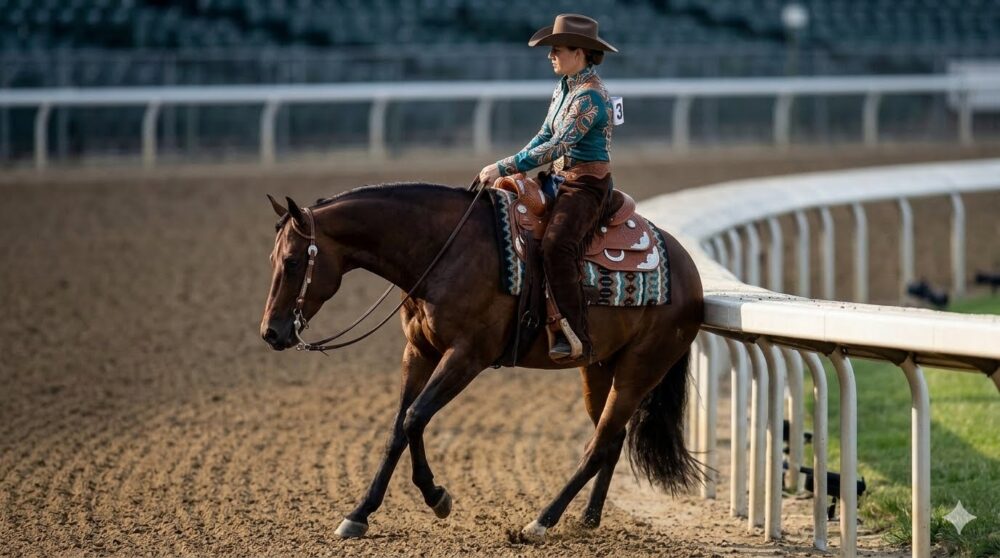
The lameness issues caused by trainers training these methods and is promoted and allowed by the Quarter Horse industries is as insane and abusive as Rollkur was to the dressage and show jumping industries. Sorry folks, just unable to accept that horses are lame and suffer daily from these rewarded practices from “horseman/women” based on current fads that follow complete and utter ignorance AND stupidity as the formal word, nescience, is too formal.
I know, way off topic about over-canting as I was definitely “ranting” but not “over- ranting”. Well maybe just a bit.
It ALL has to stop, including blaming your farrier for the nescience of the equine veterinary profession. Your farriers safety, livelihood and health is dependent on the equine veterinary profession being open to a different mindset of rethinking and learning other approaches that will help farriers sustain long lasting careers with patients that they are able to shod comfortably and easily. God only knows farriers are more open and creative then any veterinarian I have ever met as they have learned to maneuver, balance, contort, and “out-grit” a 1200 plus pound animal that is trying to throw them across the barn aisle. The amount of patience and true horsemanship farriers have for and with horses is incredible to me, as I highly respect those that I have met and had the privilege to work with and learn from. I am fortunate to know many exceptional farriers who represent their trade as professionals!
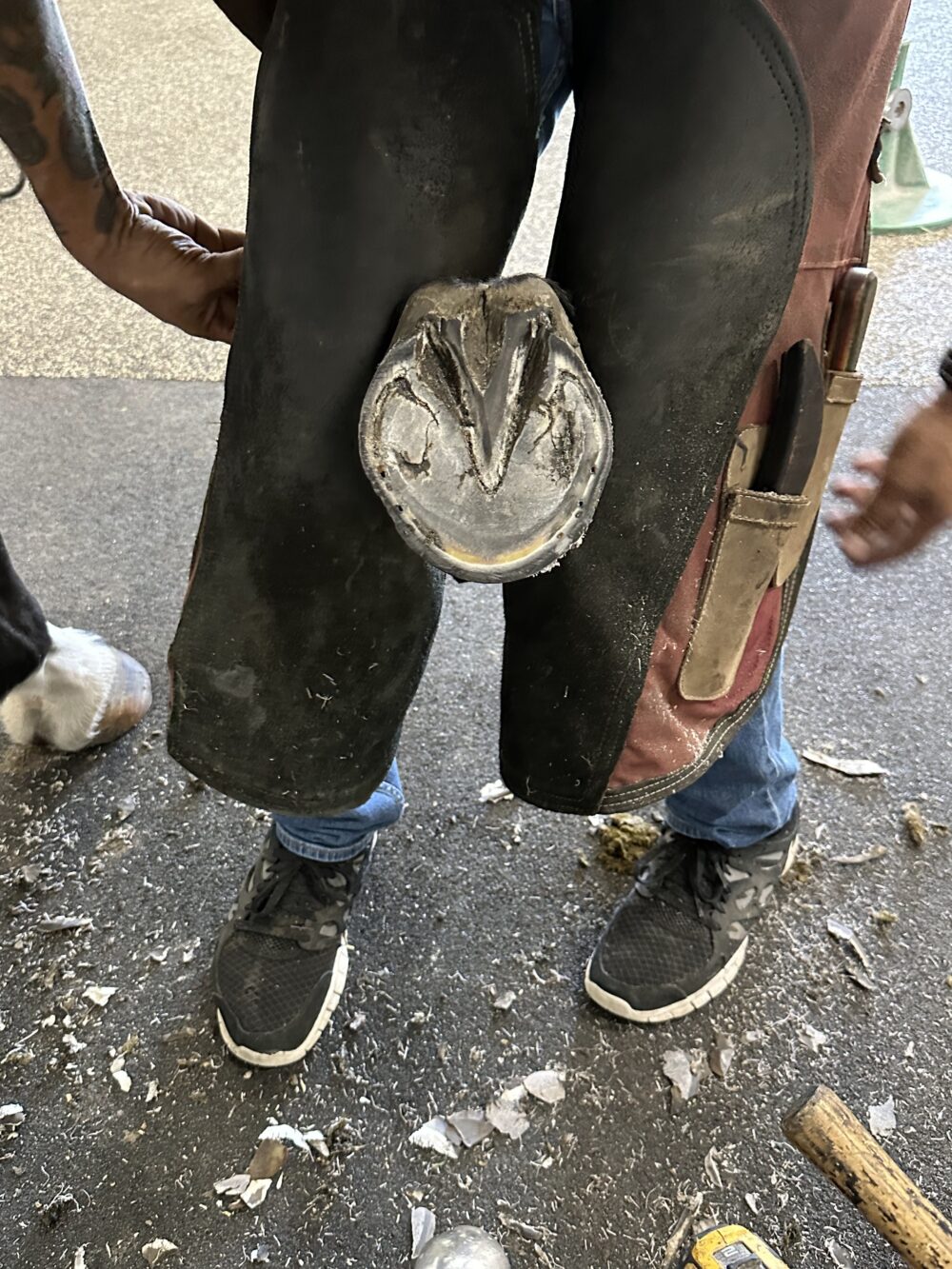
Let’s talk about how a horses hoof grows. It is a simple conception as the hoof only grows depending on how the limb loads and foot lands. The hoof does not grow depending on when the horses front limb or hind limb is extended in the air in a long sweeping stride length. It grows only depending on when the horse’s foot lands, and HOW it lands AND the limb loads! Wherever the hoof lands with the most contact to the ground, does not grow as fast as where it does not. It is that simple. If your horse lands toe-lateral then medial, your horse will always be high medially whether it is the hind or front foot. If your horse lands medially first, then it will have a lateral flare. The farrier principles of trimming and shoeing all horses to land flat is great if the horse is not lame and has normal range of motion during movement of all its limbs. Conformation is also very important to consider, however many horses are “made lame” when attempting to practice these principles of landing flat with horses that cannot pick up or have the ability to have normal range of motion of their limb(s) statically or during movement. The smaller foot will be (hind or front) the foot not bearing as much weight as the larger foot. Club feet are exceptions to this rule. Physics of weight distribution is simple and not complex as farriers understand that the larger foot side is usually the problem side, not the smaller foot side which will be the focus of lameness by the equine veterinary profession. If you look at the bottom of the foot, the sole, it also is a verification of weight bearing as each side of the sole should be equal in size not asymmetrical as the images below.
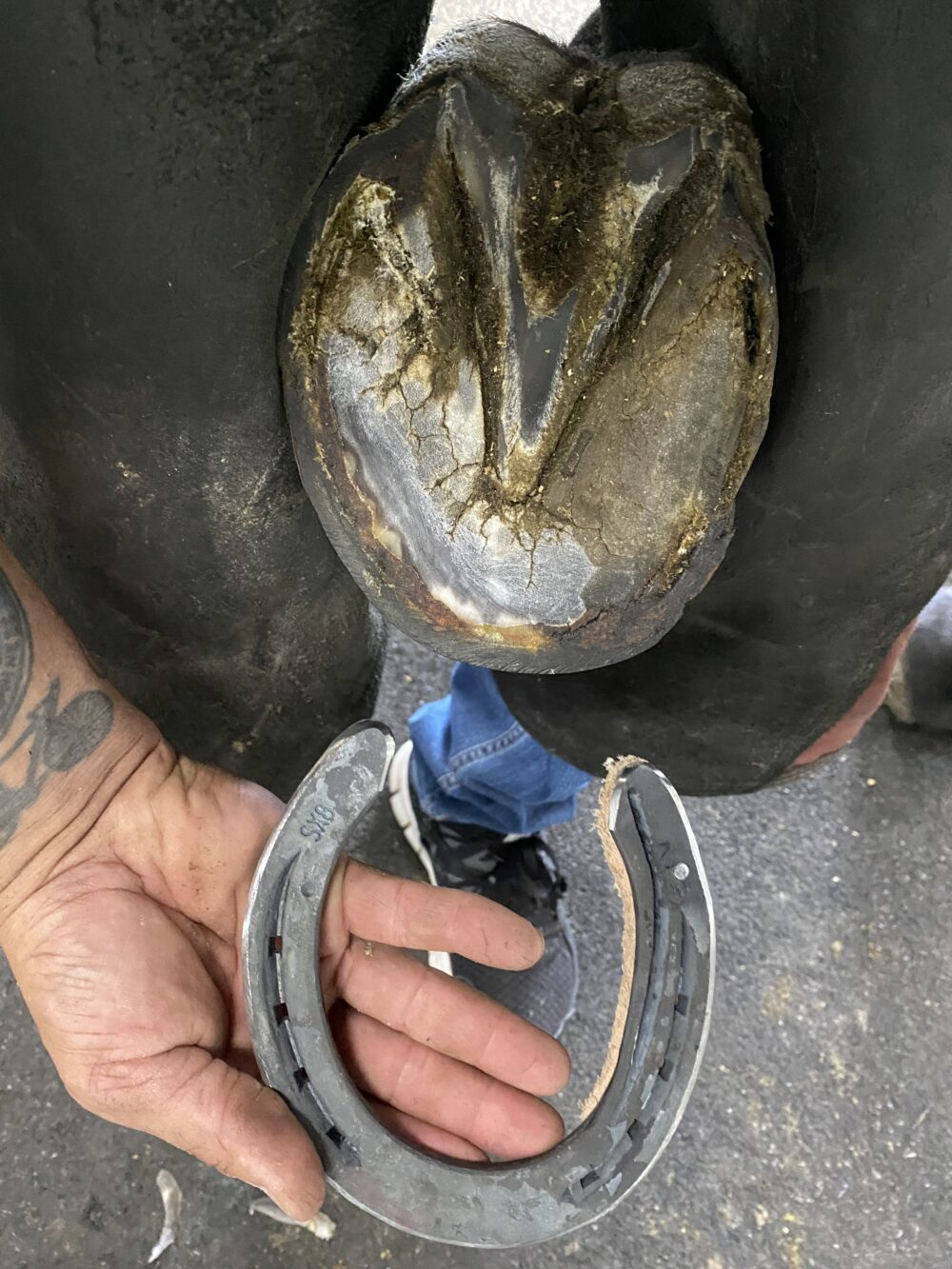
Horses that land toe first in their front limb(s) are unable to bring the limb forward during engaged movement. This is the most important point: ENGAGED MOVEMENT. The horse may be able to bring its front limb(s) forward to stretch, but that is not the same as engaged movement where the regional structures of the body have to work in coordination. The muscles controlling the ability of the scapula, lower cervical, ribcage, sternum and thoracic spine are all responsible for the movement of the front limb. The actual FOOT does not have any control of how it moves, as it does not have muscles to control its movement, only tendons and ligaments. It is ALL interconnected as one’s flexibility does not mean that you can run gracefully! Watch WNBA stars Brianna Steward, Chelsey Gray, Brittany Grinner or other professional athletes run awkwardly up and down the court/field and you will understand this concept.
In the scenario with the horse trying to “kill” the farrier when the RH limb is shod, WHY is this occurring and WHAT are the considerations? One has to have the curiosity to start asking questions.
Question: Is the horse able to pick up the limb at all? If able to get the limb up slightly, does it want to slam the limb down immediately?
Answer: If the horse cannot pick up the limb or hold it up for any amount of time it has severe lumbar pain and pelvic dysfunction. If it is one limb then it is on the same side as this is common sense to me but uncommon sense to most as to the reasons why as the biomechanics of how this region works is unknown. If both limbs are difficult to pick up and hold then very simply it is both sides and the entire region is injured.
Question: What if a horse can bring its hind limb forward but not backwards?
Answer: If the horse cannot bring the limb backwards this means that extension of the muscles and boney structures in the lumbar and pelvis and/or movement of the coxofemoral joint are affected. All of these regions and structures need to be assessed. The “SI” DOES NOT MOVE so please do not go down that road of illogical thought which is insanity.
Question: What if the horse can bring the hind limb backwards but not forward?
Answer: Again all of the structures of the lumbar-pelvic-coxofemoral regions including Ischium and Hamstrings also need to be included in assessment.
To understand form and function of any horse is the key to resolving the pain and discomfort horses are experiencing while the farrier is trying to get their job done. The solutions to these problems are regional problems, like Shivers horses, based on anatomical sections of how a horse biomechanically works. Treatment of one “thing” or structure (“SI”) will not improve the horses ability to pick its limb as this region, the lumbar-pelvic-coxofemoral region work and move together in unison. It is understanding regional sections and biomechanics of how all these structures work together for a horse to simply pick up and hold its limb in any direction and angle so the farrier can get their job done safely and comfortably.
Thank you to all the farriers who I support with my whole-heart. I am trying to educate my own profession to help you have a safe long lasting career trimming and shoeing horses. Many a farrier knows, your professional opinion falls on mute ears and blind eyes from the “highly educated” and “Ism-Isms” who cannot do your job, but have many “opinions” of your work as a farrier. I have not, nor will I EVER tell a farrier how to do his or her job as it is definitely not my lane. I am simply trying to pave a new lane and paradigm so that it is a smoother and less bumpy ride for farriers and sport horses.
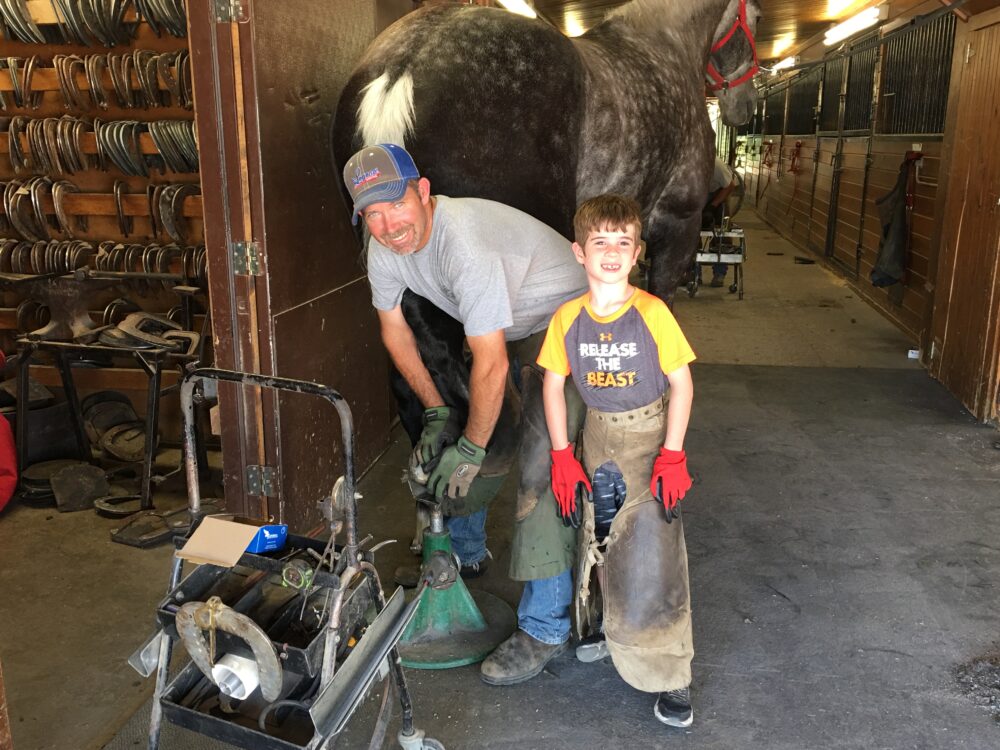
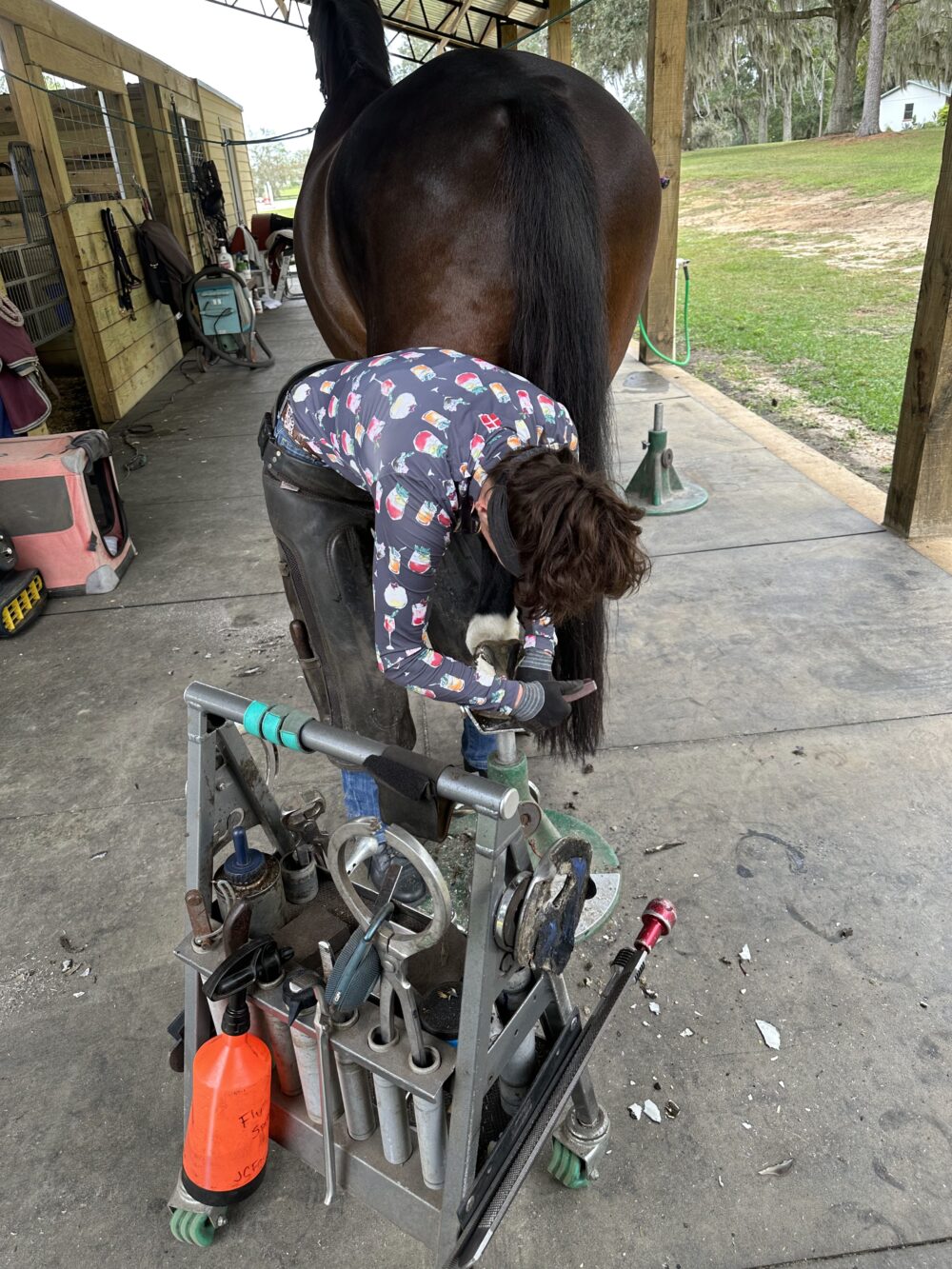
I need your help to do this.
Be the Voice. Be the Advocate. Always put The Horse First.
Please share this blog with your horse friends and farriers to bring more change to the sport horse world.
AJD
Be the first to comment