
Why Do Horses Bulge Their “Shoulder”?
Hello Everyone!
Today’s blog is going to dive into WHY horses “bulge” their shoulders?
Since we all agree unanimously that horses have 4 legs, 2 shoulders and SI’s. Do horses have scapulas?
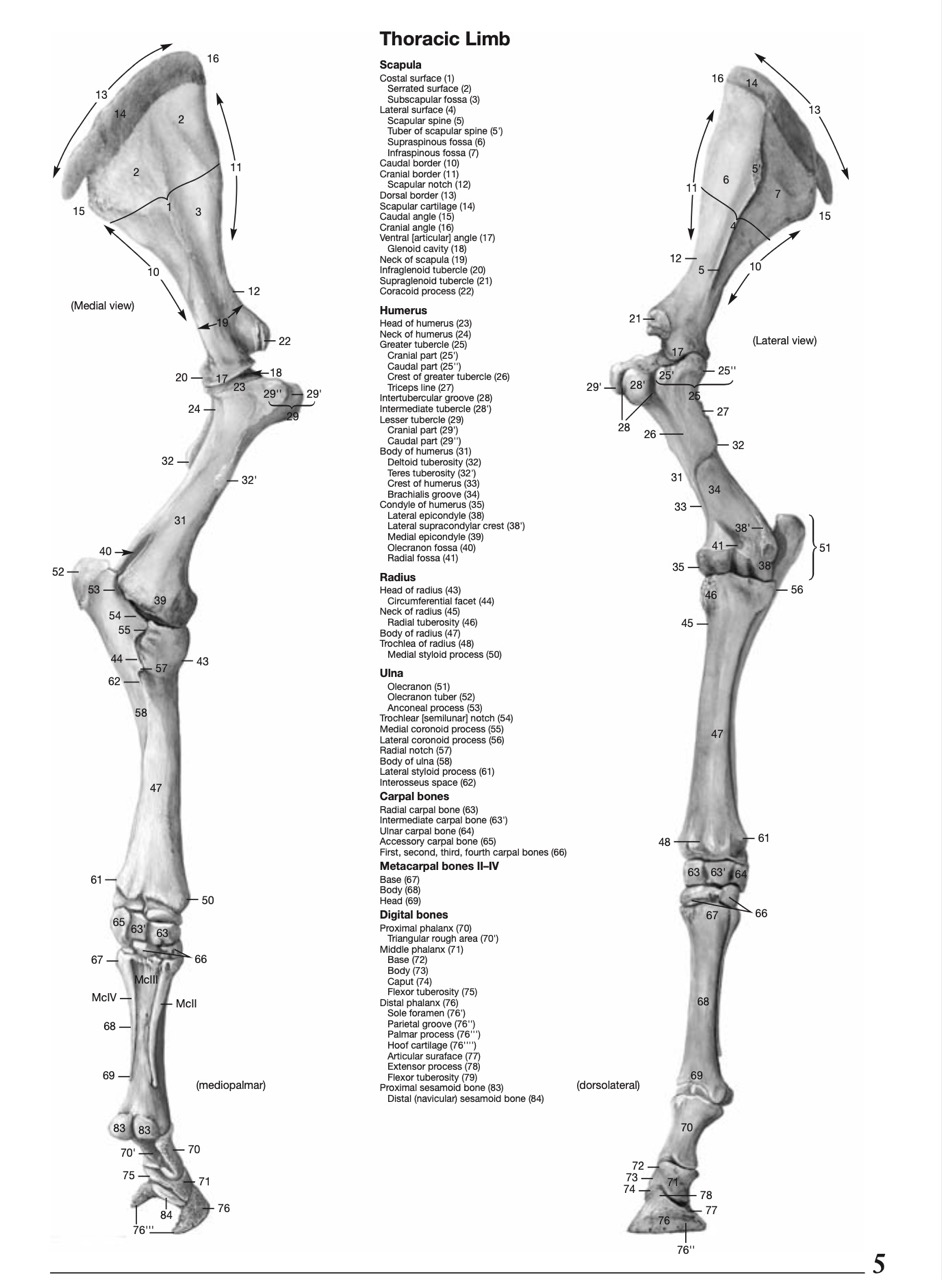 When was the last time you heard someone say that “My horse bulges its SCAPULA“?
What does everyone say? “My horse bulges its SHOULDER”.
The majority of horse people hardly EVER use the word SCAPULA! This includes grooms, owners, trainers, saddle fitters, physiotherapists, equipment reps (pads, girths, saddles), modality reps (shockwave, PEMF etc) and veterinarians. Everyone always says SHOULDER as they are pointing to or referring to, the scapula.
Questions:
Did you know that the SCAPULA is the longest bone in the front limb of the horse?
Did you know that the scapula has flexible hyaline cartilage around the top of scapula that is damaged and eroded away by the pressure of equipment?
Did you know that the bone-cartilage interface (where they join) of the scapula becomes extremely painful to horses when injury occurs to the cartilage?
Did you know that there are many muscles and soft tissue structures surrounding and attaching to the scapula and cartilage that get injured and affect the movement of the front limb?
Answers: The majority of people and veterinarians will answer all the questions with the answer: NO.
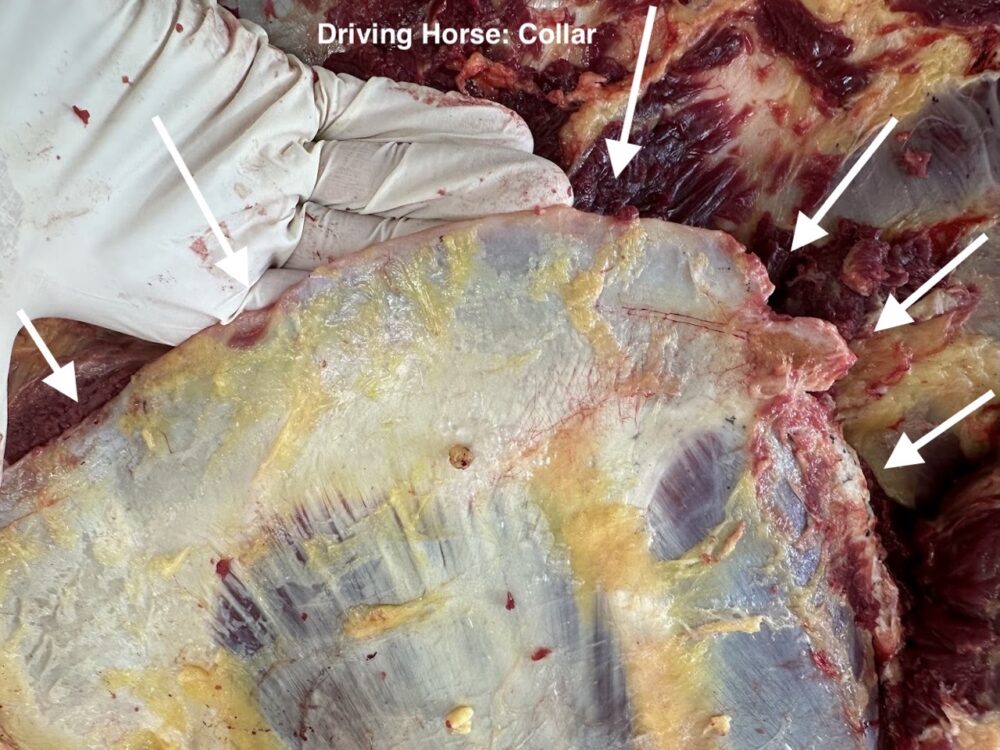
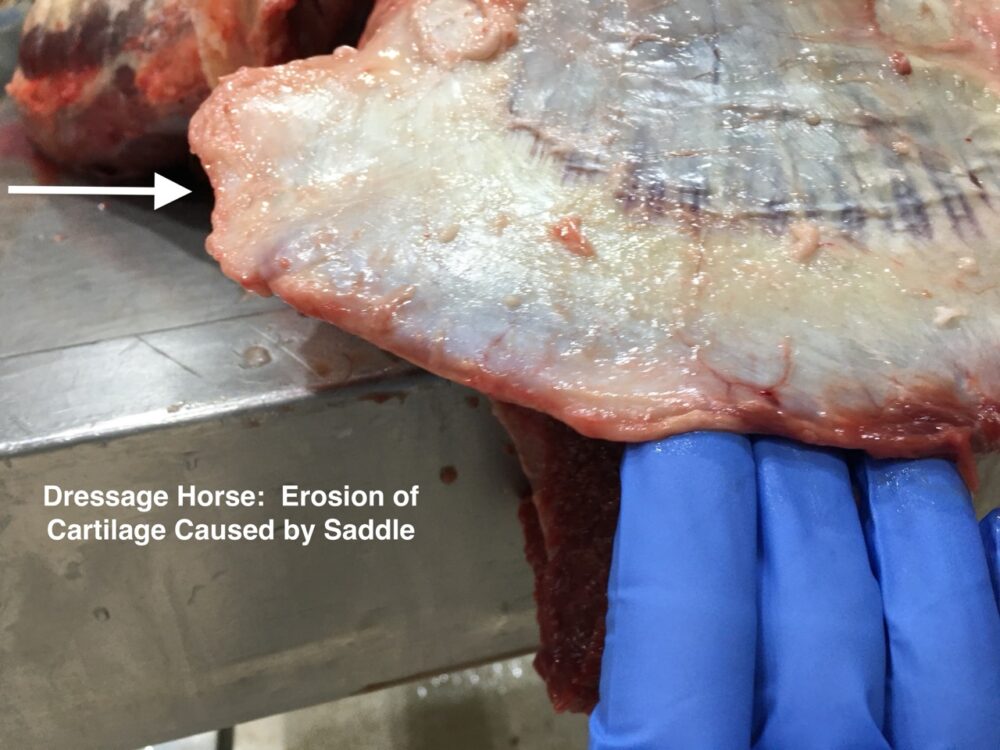
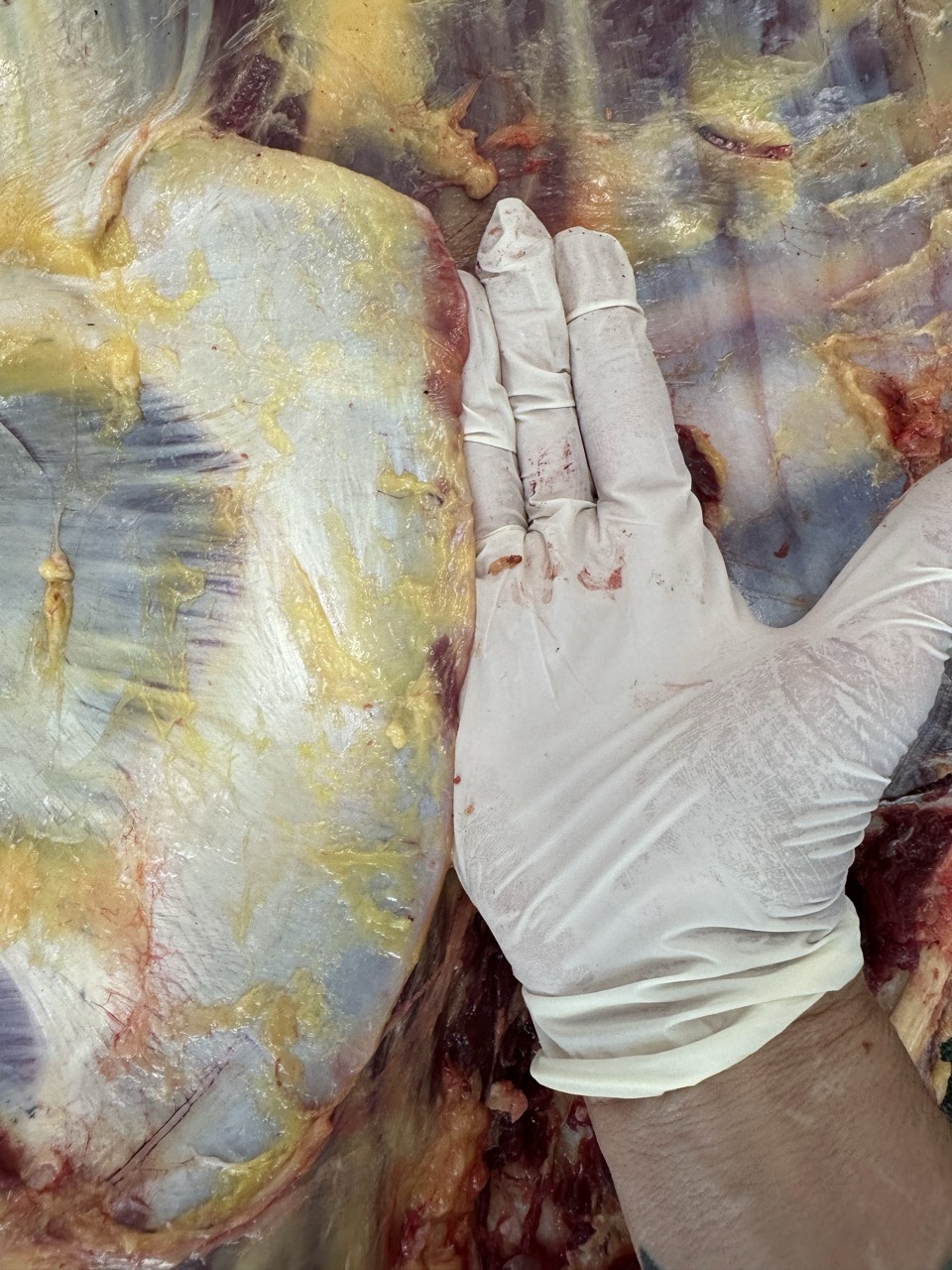
Below are images of scapular damage occurring by equipment. The first is a draft horse that wore a collar to the front margins of the scapular bone and cartilage. The second image is of a dressage horse with extensive erosion of the caudal cartilage caused from saddle pressure. The last two images are from the same horse on necropsy. This horse was ridden western where the saddle was placed on top of the scapula.
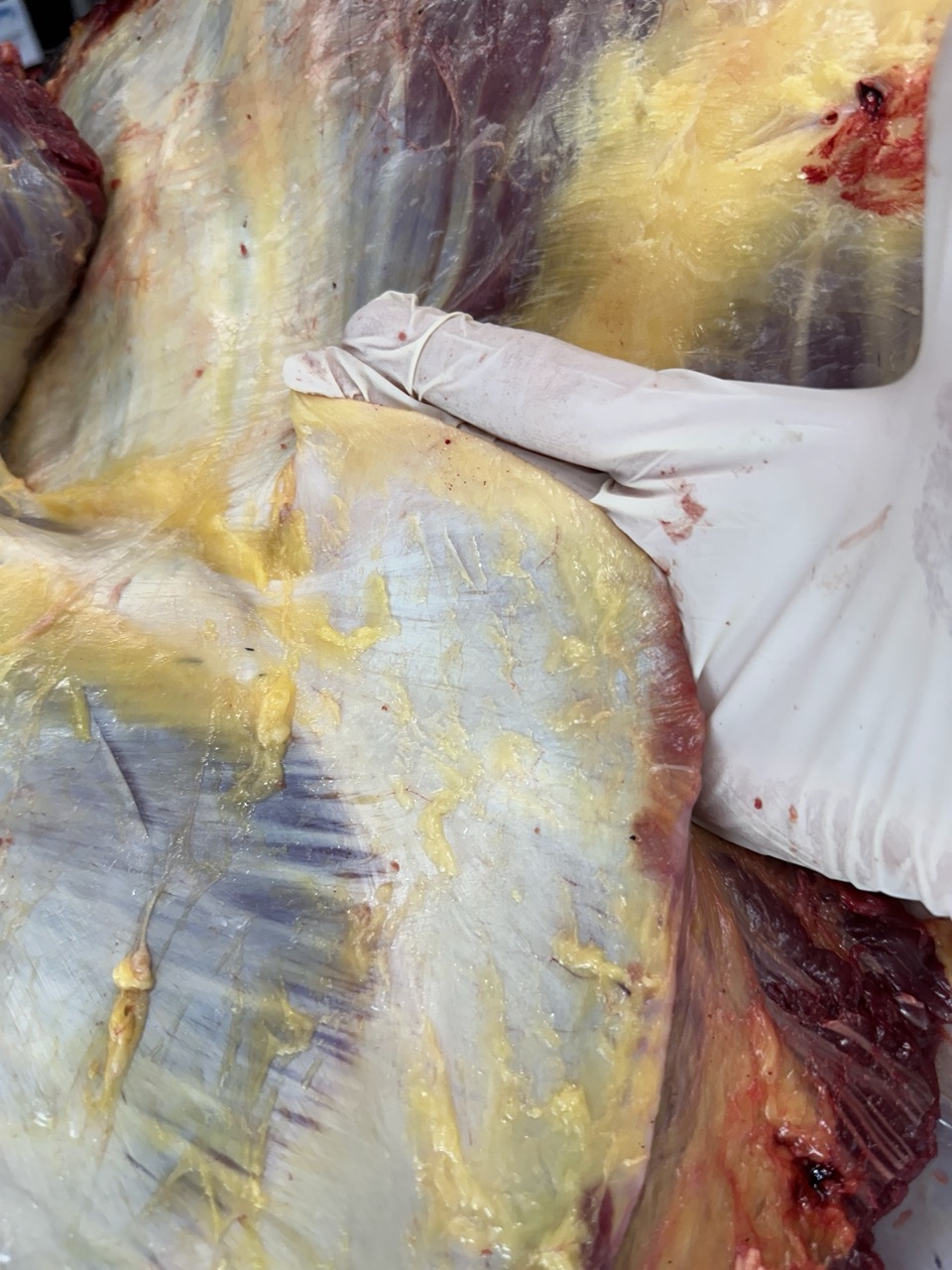
Interestingly, thus far in my career, I have met and worked with only two people, both saddle fitters, Rose Schwinghamer and Amanda Anderson, who used the CORRECT anatomical terminology, scapula. It is why I am naming them, plus they are excellent saddle fitters. Have not met a veterinarian, physiotherapist or anyone in the horse industry that uses the CORRECT anatomical identification for the scapula. It is always the “shoulder” when pointing, touching or referring to the scapula, thus why I named Rose and Amanda for being awesome at their jobs, but using correct terminology!
The only time people use the word scapula in reference to horses is when a horse is injured and develops Sweeney, or in medical terms Suprascapular Neuropathy. This is a condition involving atrophy of the scapular muscles typically caused by damage to the suprascapular nerve.
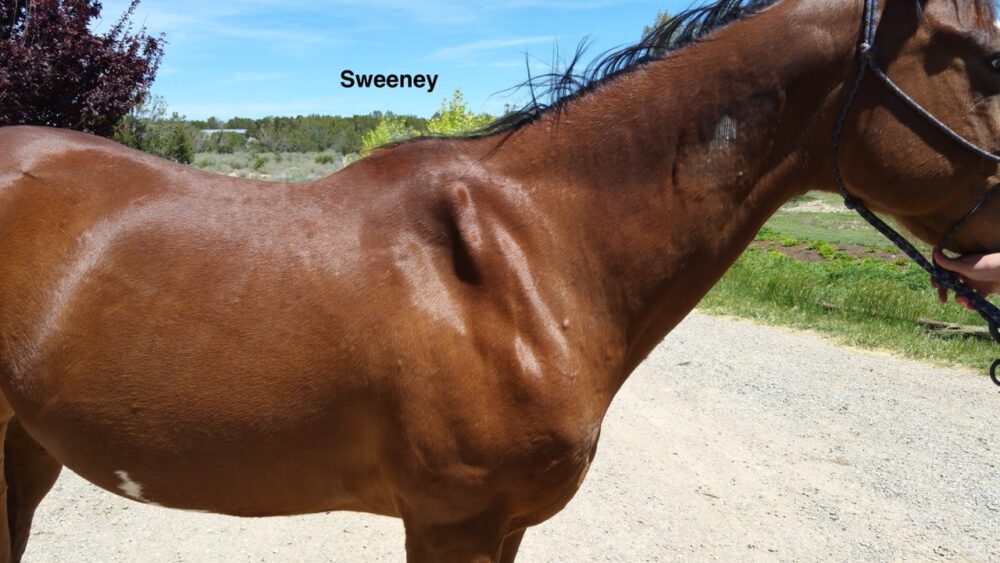
Another question is: Are they bulging their scapula or shoulder? Seems like a very simple answer to me as it is their shoulder JOINT that bulges. Correct?
However the REAL question one needs to ask is WHY does a horse “BULGE” its SHOULDER?
Where did the confusion or mislabeling of terminology come from? Butchers use the term “shoulder blade” instead of scapula. After processing the scapula, they are referred to as “country ribs”. Maybe that is where it all started. In the human body people refer to their shoulder as the actual shoulder joint, but also intermingle saying shoulder blades versus scapula.
Google AI states:
The word scapula originates from the Classical Latin scapulae (plural), meaning “shoulders” or “shoulder blades,” and gained its modern anatomical meaning via Late Latin. It is likely derived from the Indo-European root *skap- or *skep- (to cut, scrape), suggesting a connection to tools, as they were thought to resemble spades or shovels.
• Etymological Roots: The term is linked to the idea of a flat, digging tool (spade/shovel), likely because early humans used animal shoulder blades for digging.
• Latin Origin: Scapulae referred to the shoulder blades. The term was popularized in modern anatomy by Andreas Vesalius in 1543.
• Greek Relation: The Greek equivalent, omopláti, comes from ómos (shoulder) and pláti (flat/back), reinforcing the anatomical location and shape
• Related Words: The word scapular (a religious garment) comes from the same Latin root scapula (shoulder), originally referring to a garment covering the shoulders.
Since there is intermingling of terminology using “shoulder blade” referring to the scapula and thus the term “shoulder” has become a referenced misnomer of juxtapositional confusion. What do I mean by “misnomer of juxtapositional confusion”? It means using the incorrect terminology for an anatomical structure that is adjoined together, does not make it that structure. It is 100% INCORRECT. Your ankle is not your knee just because they are connected by bones. Your wrist is not your elbow though connected. Your collarbone is not your shoulder though connected. Your shoulder is NOT your scapula though connected. Do I need to continue? I think that you get my point. Remember the old rhyme…
“The Toe bone is connected to the foot bone
The Foot bone is connected to the ankle bone
The Ankle bone is connected to the leg bone
The Leg bone is connected to the knee bone
The Knee bone is connected to the thigh bone”…..
Maybe this old rhyme is the cause? I do not care what “the cause” of this misnomer may be, we simply have a problem to solve.
Solving the problem of WHY horses bulge their “shoulders” will NEVER be addressed properly, nor ever figured out as a lameness or biomechanical dysfunction issue, if the anatomical structures are not considered and stated properly.
For everyone reading this blog, please raise your right hand and pledge this oath. AND yes you have to say it out loud or you have not taken an oath:
“I will, your name, from now to the end of time refer to the SCAPULA of a horse as the SCAPULA and NOT as the SHOULDER”.
You may now lower your hand and thank you! Do you know WHY it is important to take this oath and to use the correct anatomical terminology? BECAUSE… WE DO NOT FIT SADDLES TO A HORSES SHOULDERS OR ON THEIR SHOULDERS! I would love to see someone trying to ride a horse with a saddle strapped around both shoulders. You would be riding UNDER the horses neck with your arms and legs hanging around neck. Would be an interesting ride for sure. Below is the only picture I could find online of this occurring though the rider was actually riding the horse with saddle in the correct position on the thoracic spine, behind or on the caudal aspect of the scapulas with the girth around ribcage.
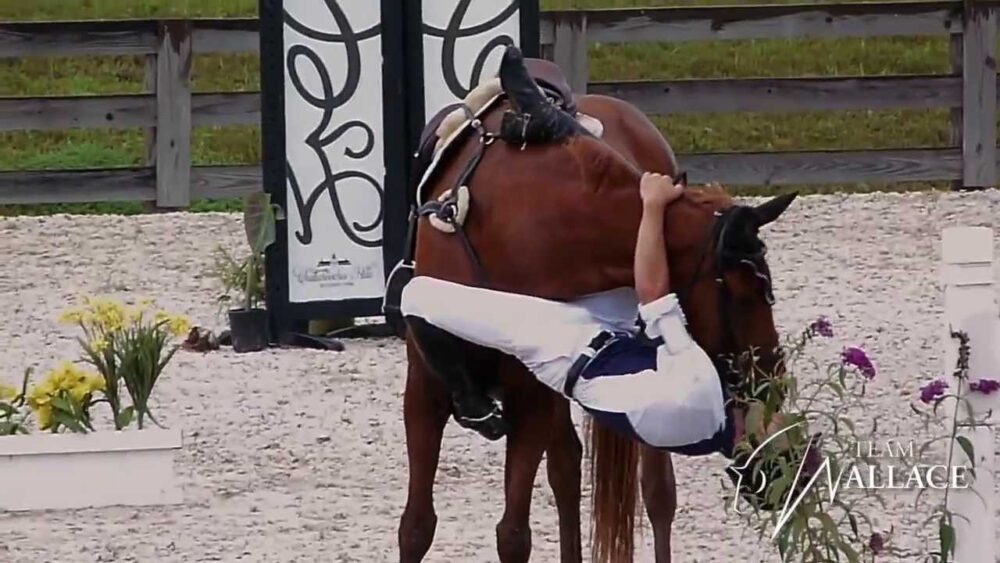
In this picture you can see that the rider used a breast collar on the horse? WHY do people use breast collars? Traditionally they are used to stabilize the saddle and prevent it from slipping back during uphill work. Cruppers are used in harness for the same reason in stabilization of the traces when backing and for downhill pack work. Jumping is sport of jumping up and landing downhill or obstacles/jumps, so why do people use breast collars for this sport that does not require long uphill climbs like endurance, competitive trail, trail riding and pack horses? Roping, bulldogging and rodeo horses wear breast collars for another purpose as it aids in dynamic lateral and uneven torsions in various directions that occur in each of these disciplines.
The real question is, WHY are breast collars used in English disciplines?
Answer: To prevent the saddles from slipping back.
The next question that needs to be asked is: WHY is the saddle slipping back?
Answer: Because there is not even (asymmetry) musculature or there is muscle atrophy where the saddle sits on the horses back. Thus one uses a breast collar to aid in prevention of the saddle slipping back.
What structures are involved?
1. Scapulas
2. Thoracic Spine
3. Ribcage
4. Muscle, ligaments, fascia, cartilage, vasculature, nerves in this region
I might clearly point out that NO WHERE in this list was the SHOULDER!
Next Question:
What is causing muscle atrophy, thus the effect of the saddle to slip back or to be uneven in this region?
Answer Options:
Equipment: Collar, Harness, Surcingle, Saddle
Pressure Atrophy of Musculature from Equipment
Injury from Unknown Cause
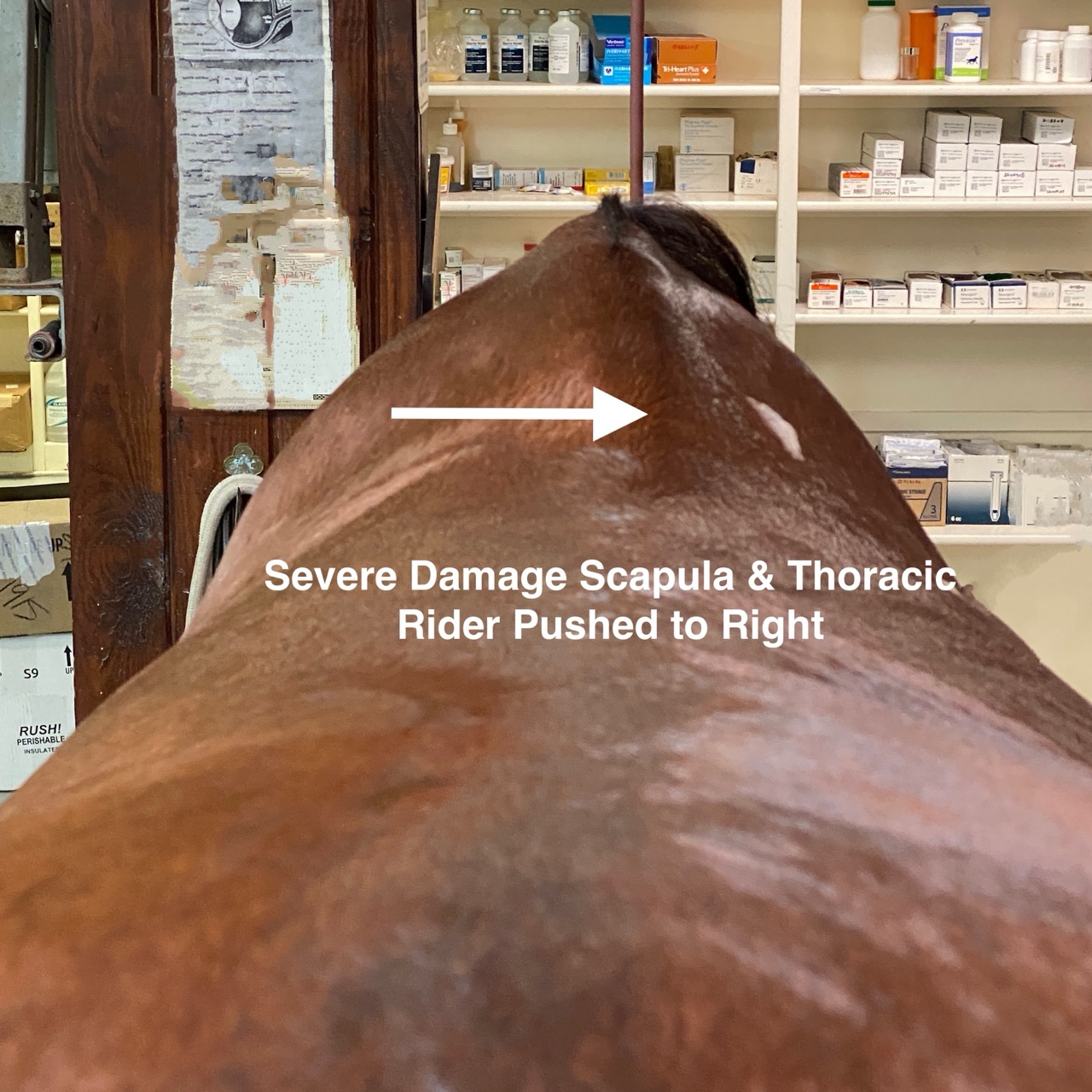
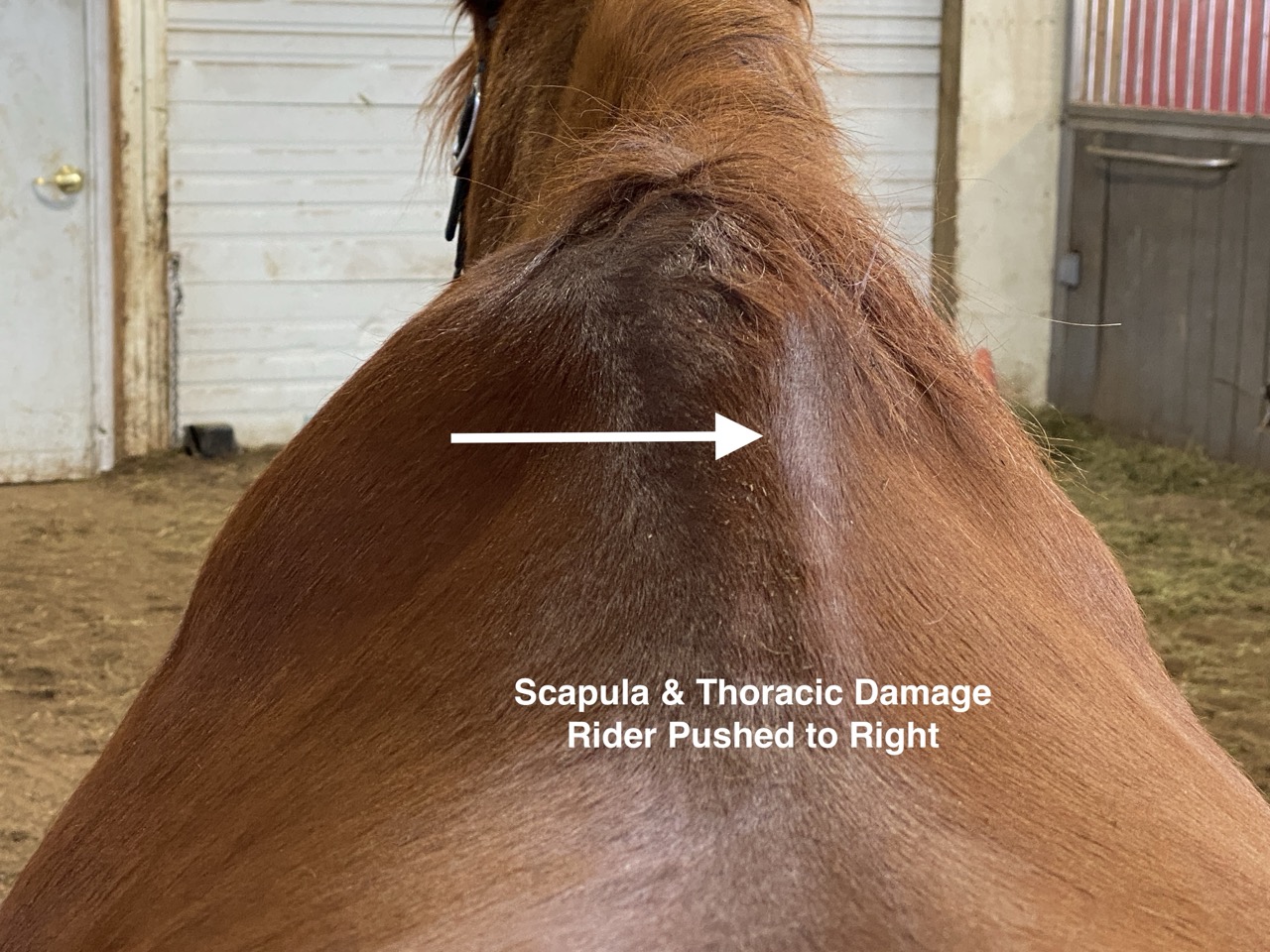
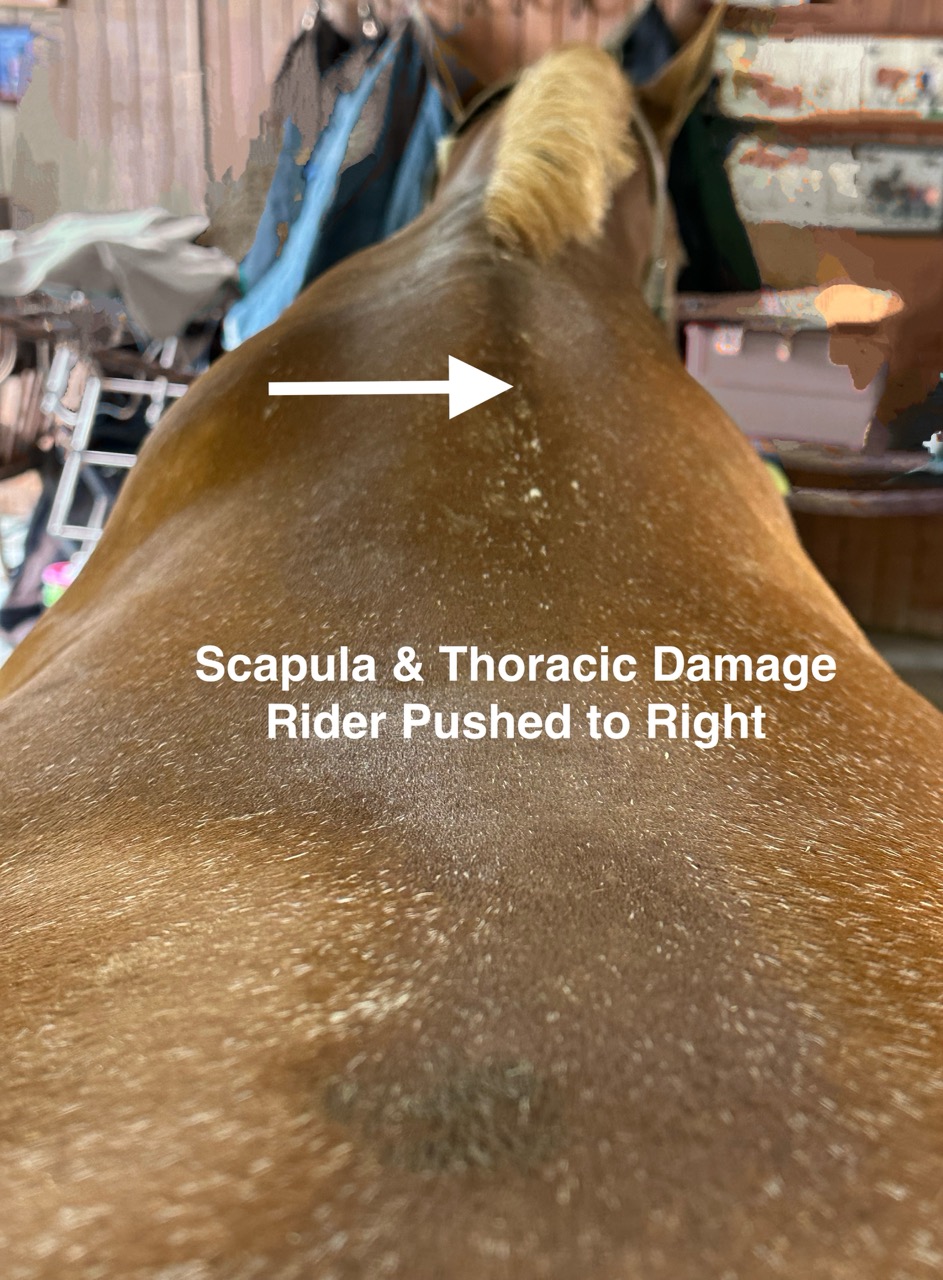
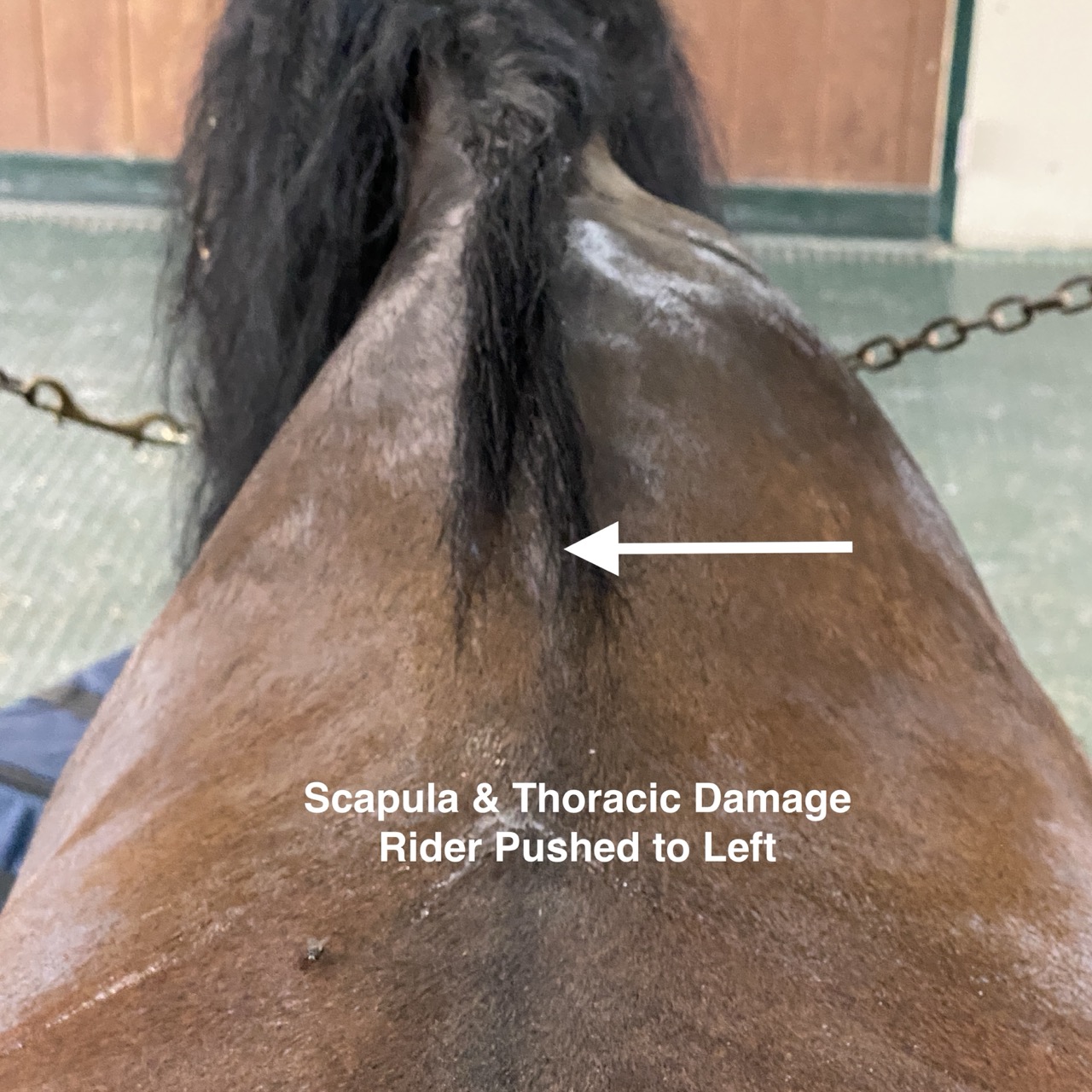
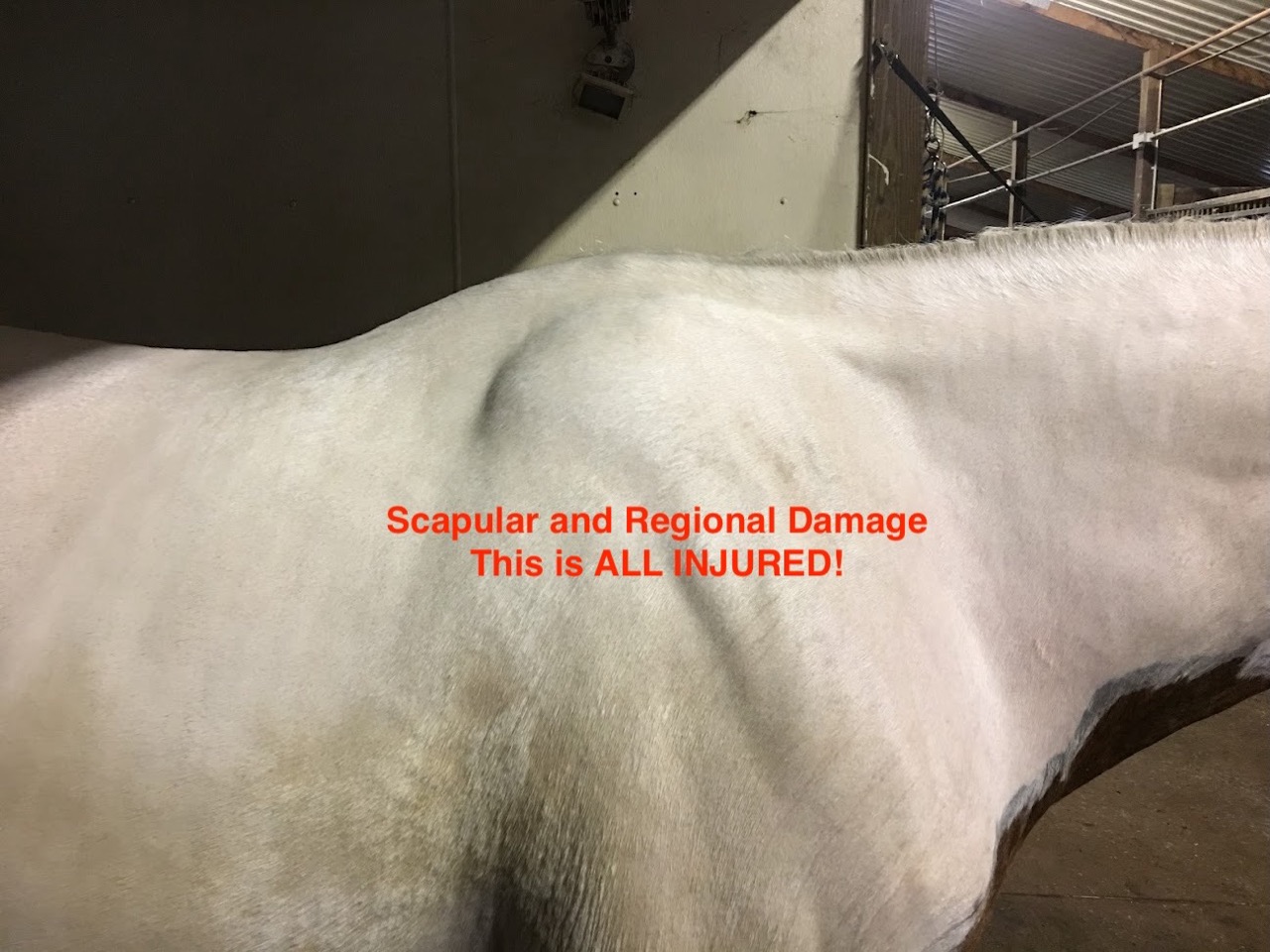
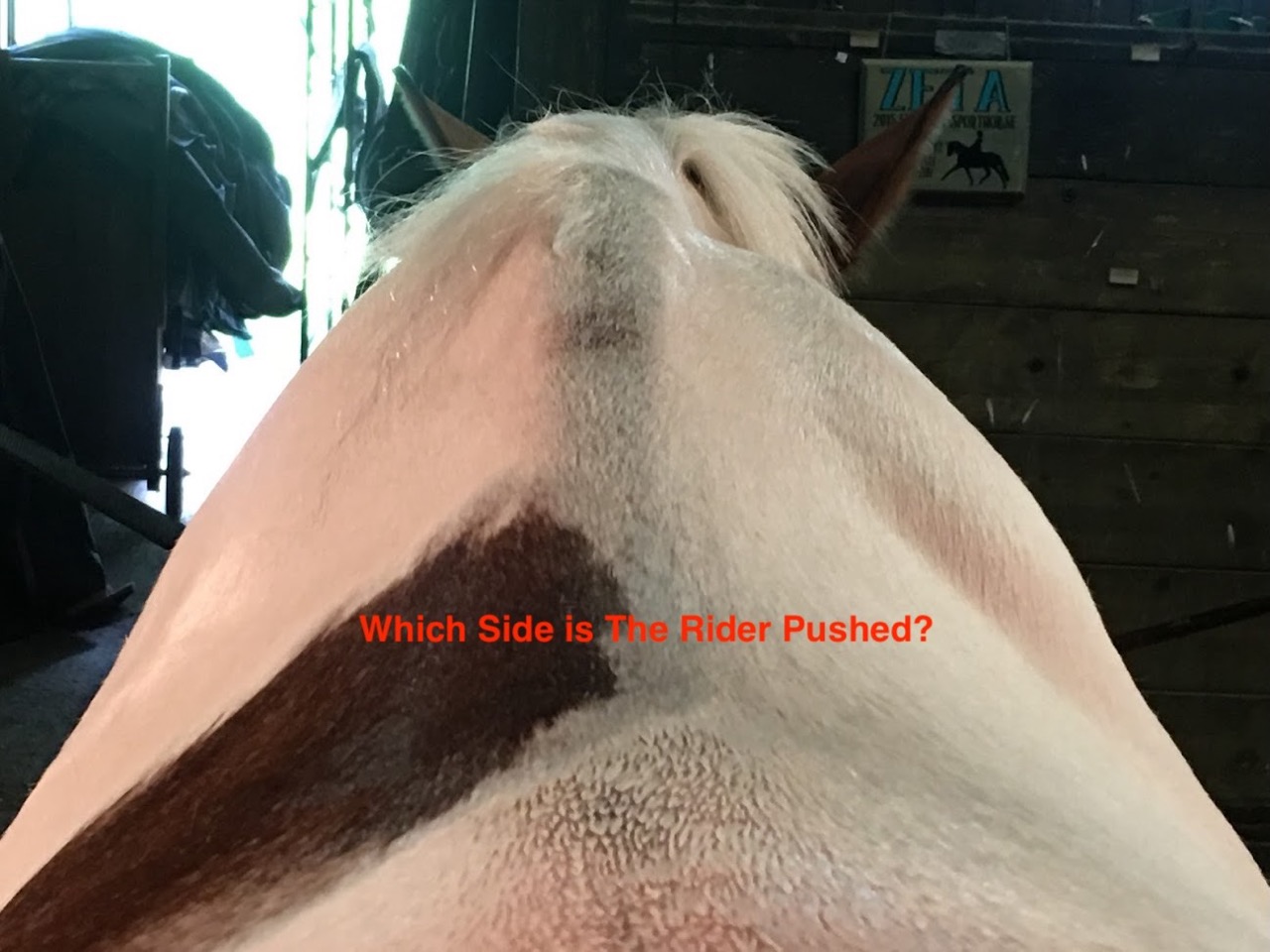
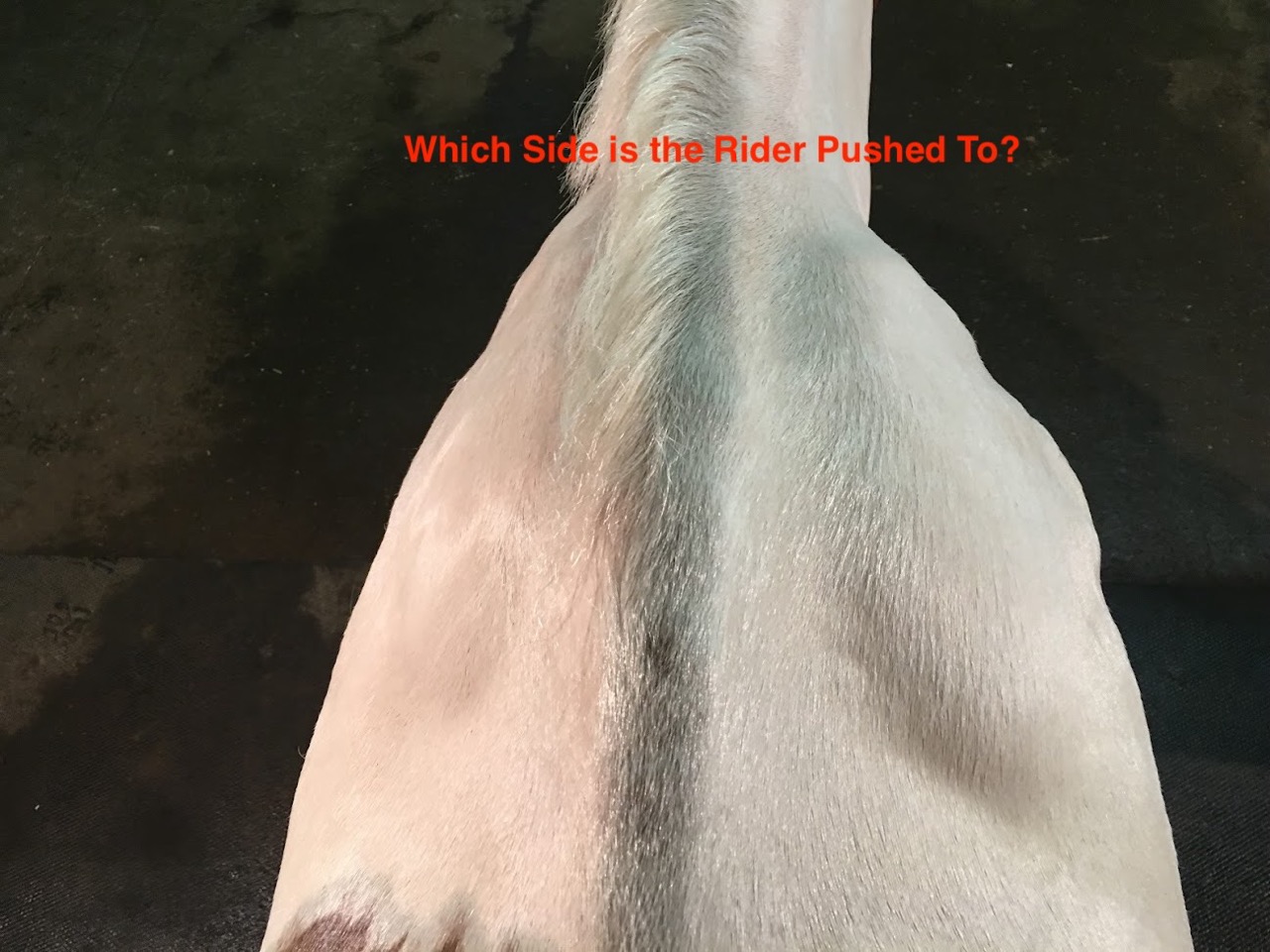
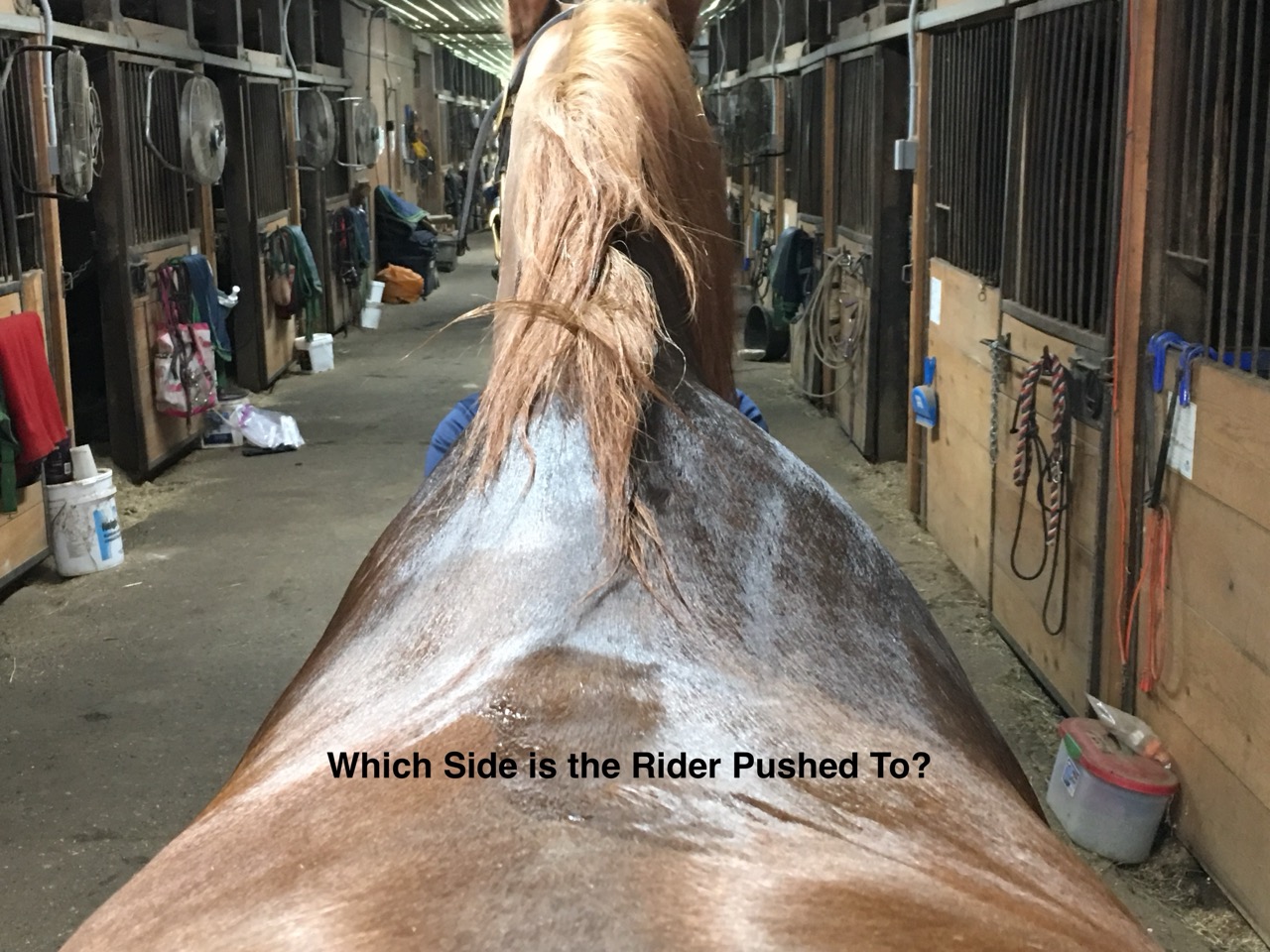
Below are 28 images of injury and damage not only to the scapula, but also to the surrounding attachments to the thoracic spine and ribcage due to the attachment of the girth or surcingle. The injured structures include muscle damage, fascia and fascial attachment damage, ligament damaged, vascular damage, nerve damage and bone damage. Everything in that REGION can be injured and have damage, thus affects/effects normal functional biomechanical movement. I have an entire library of these images that I have taken of my patient population AND their front feet. Yes, another abyss of logical scientific data that no one else has recognized in the veterinary profession, showing a distinct pattern and direct correlation between scapular damage and how the horses feet grow. That information will be in a future blog.
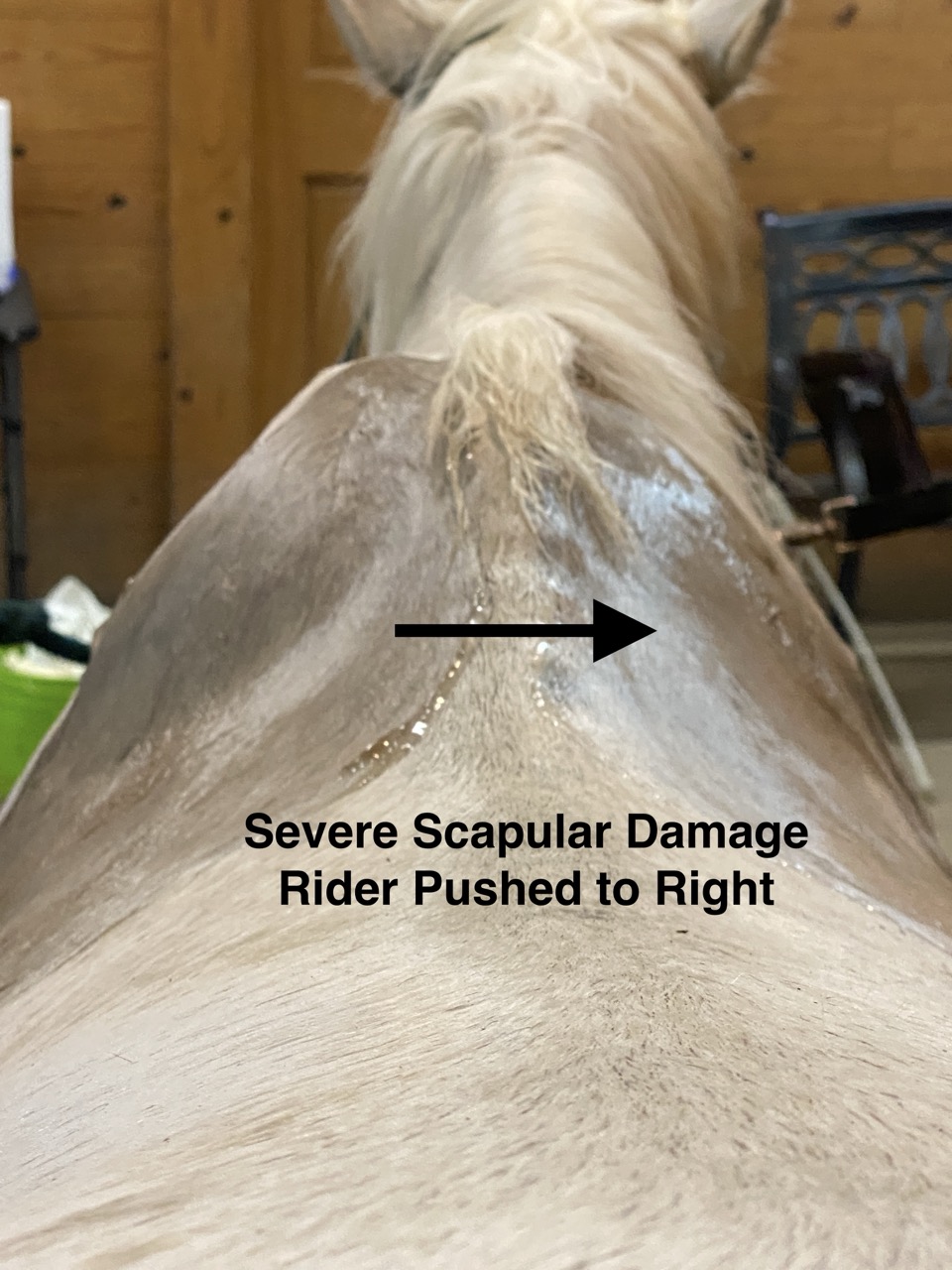
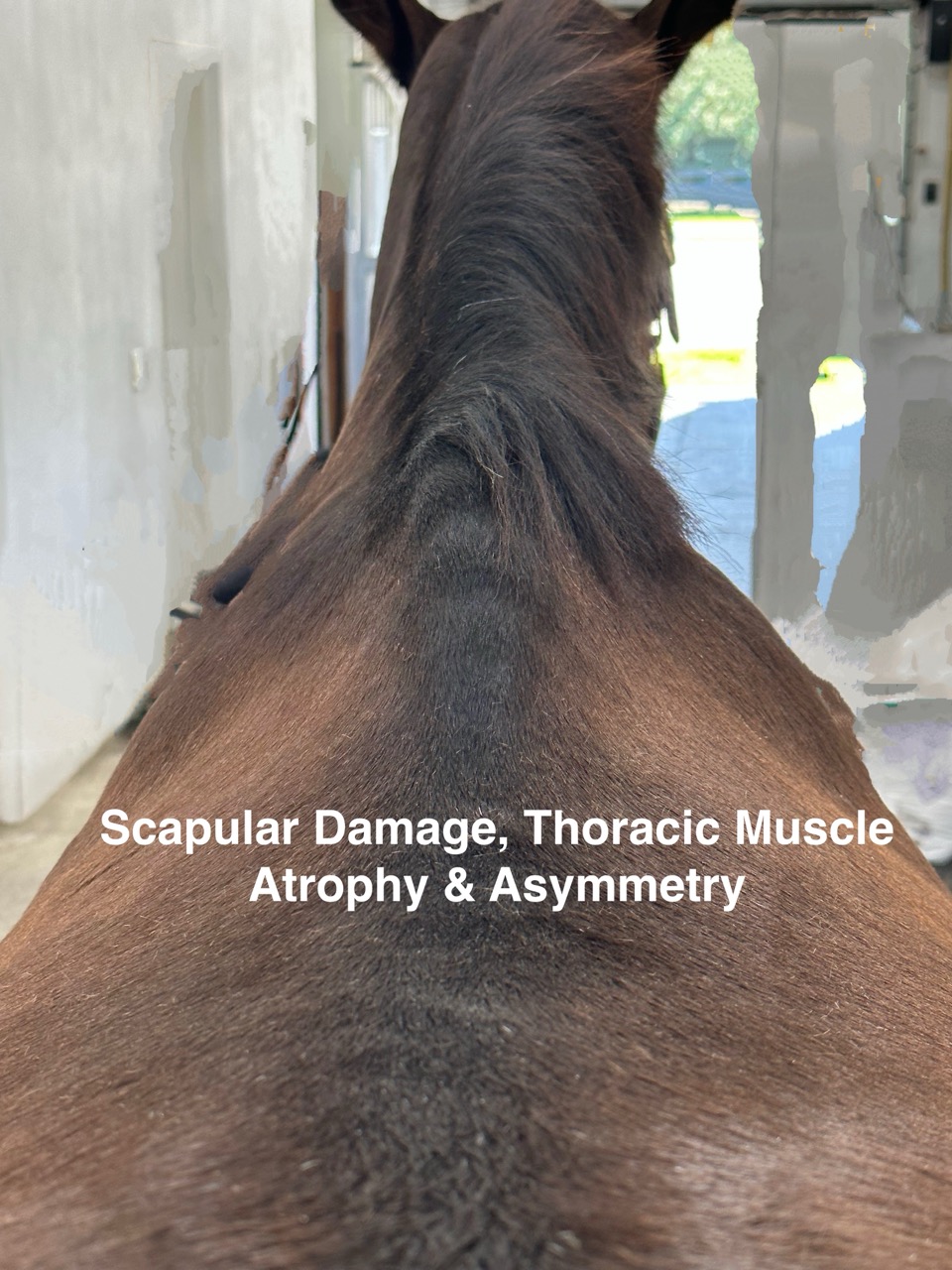
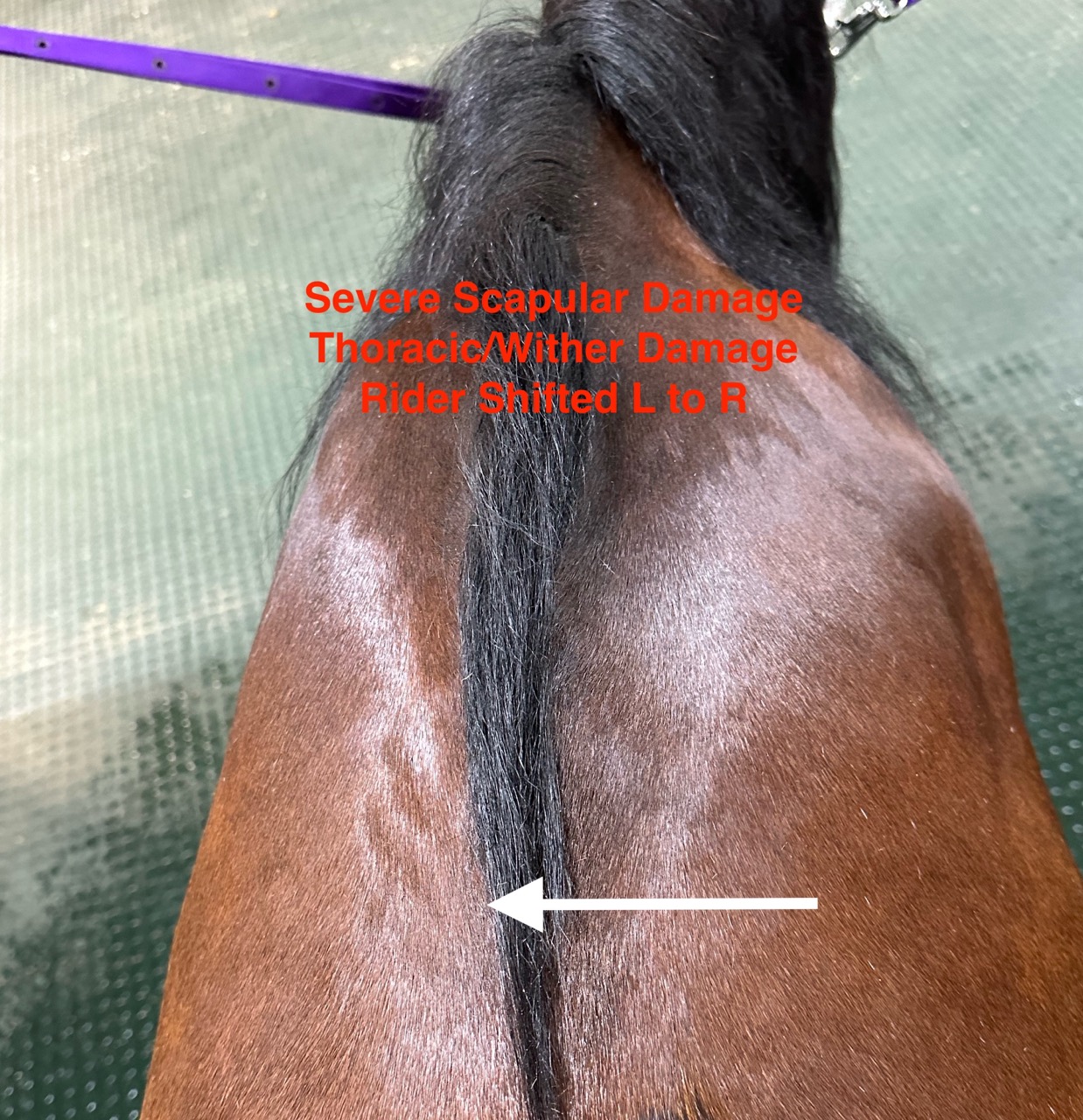
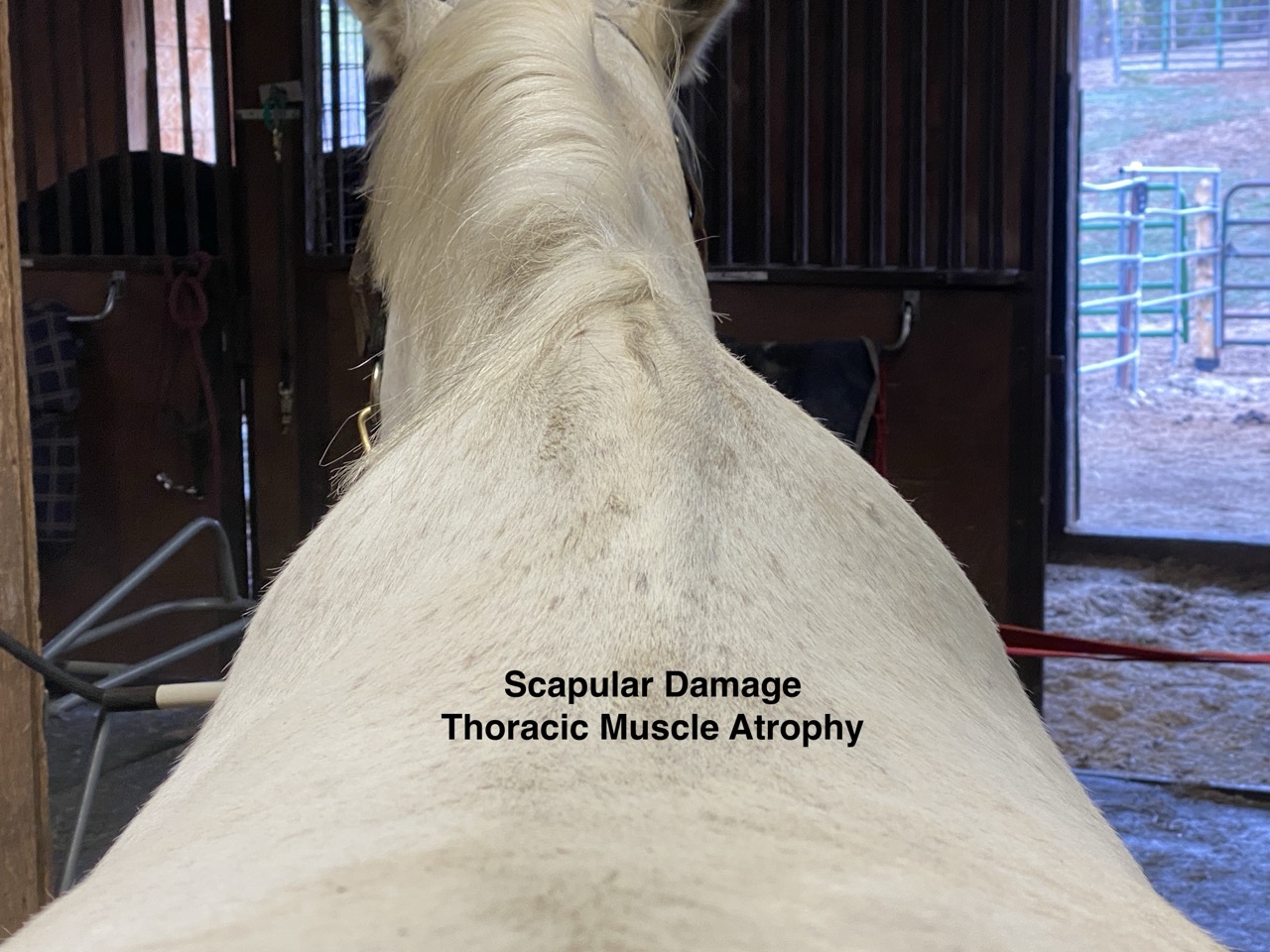
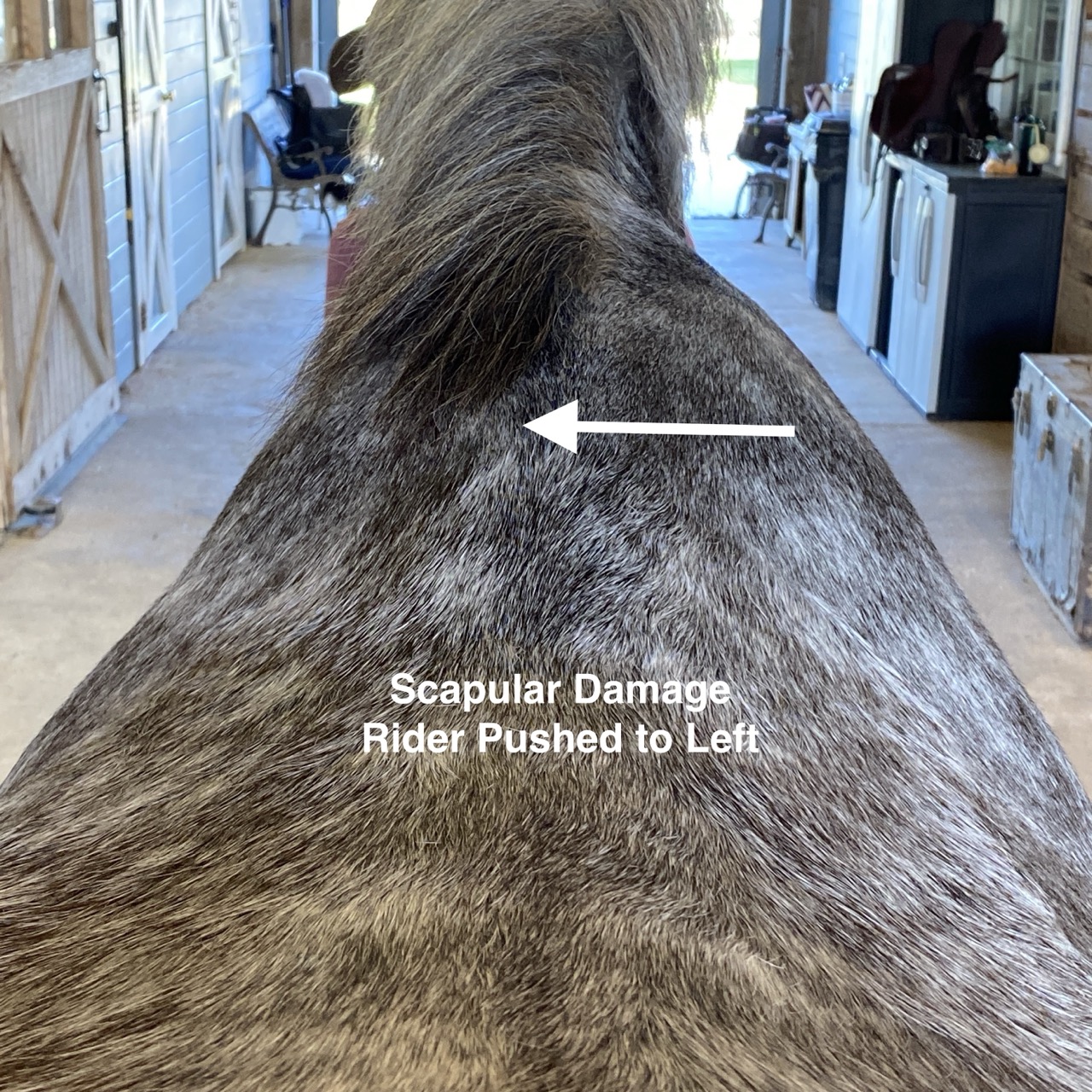
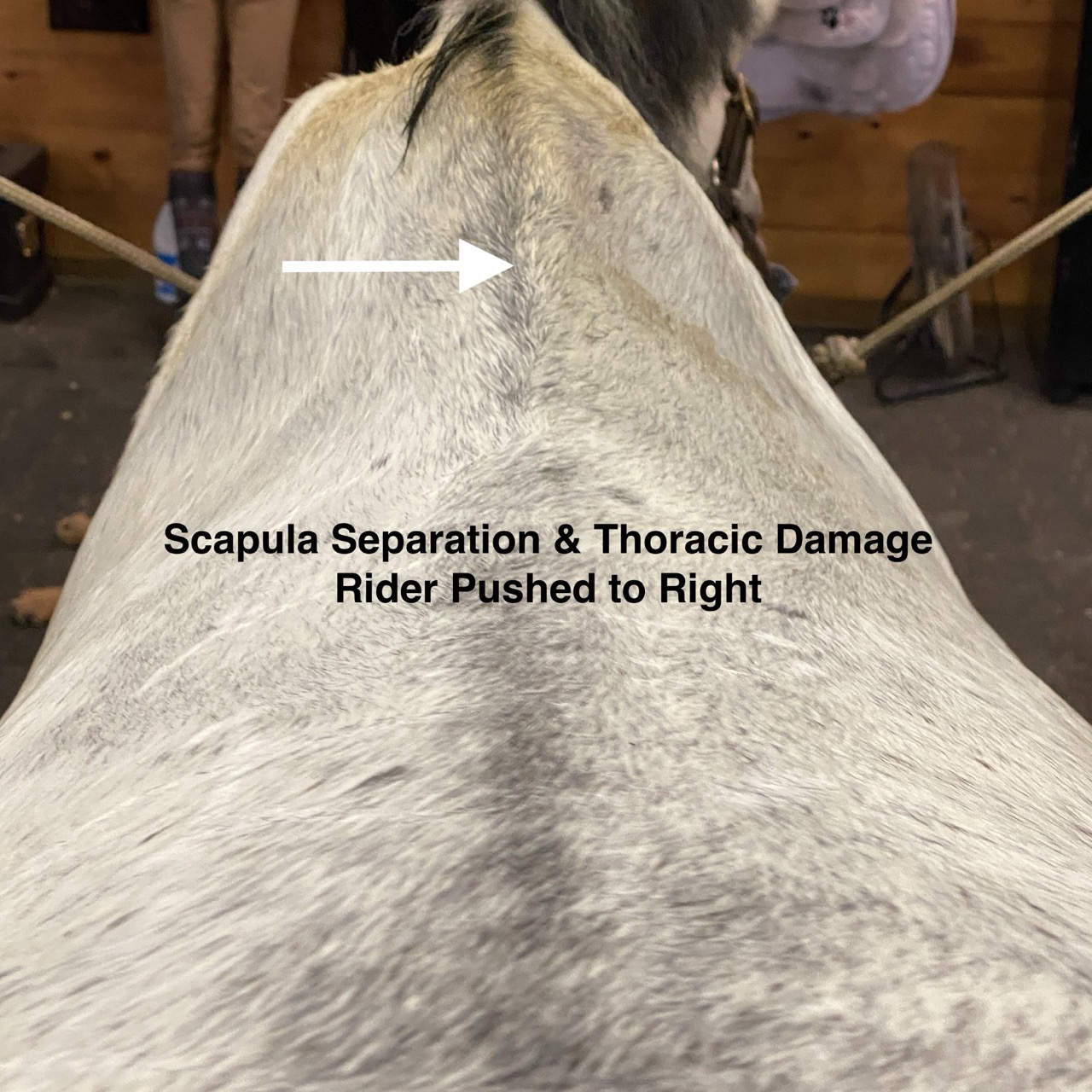
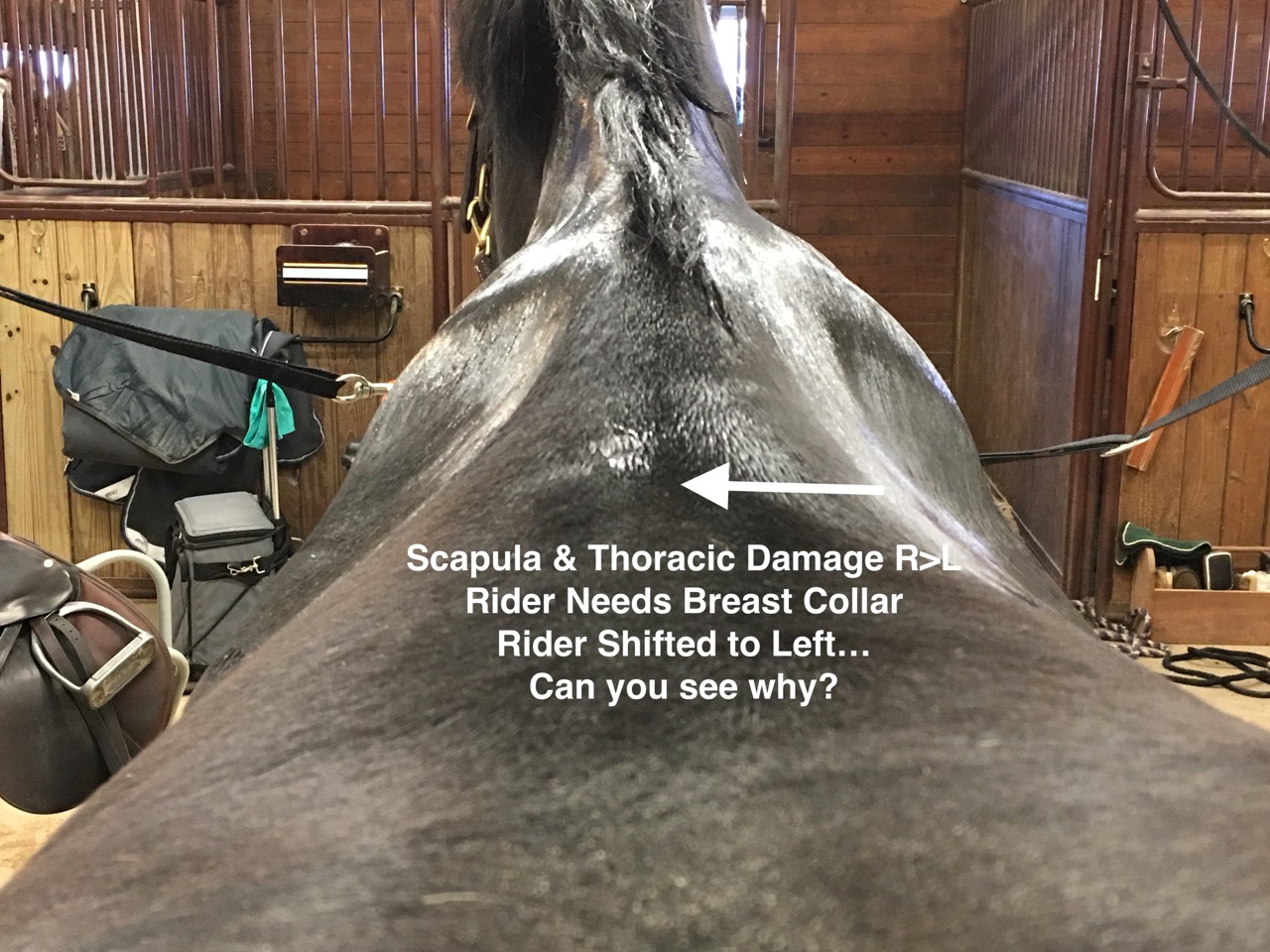
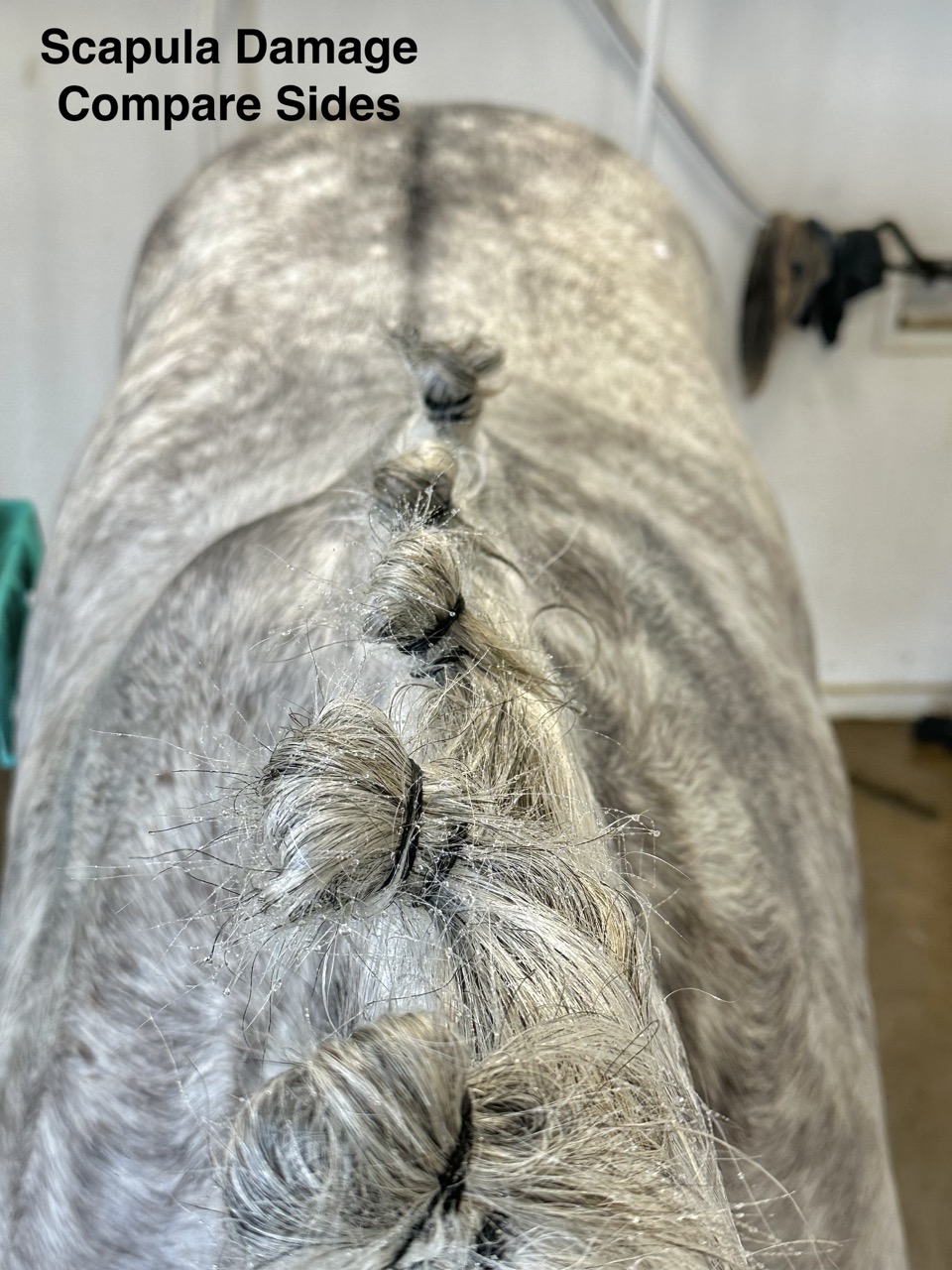
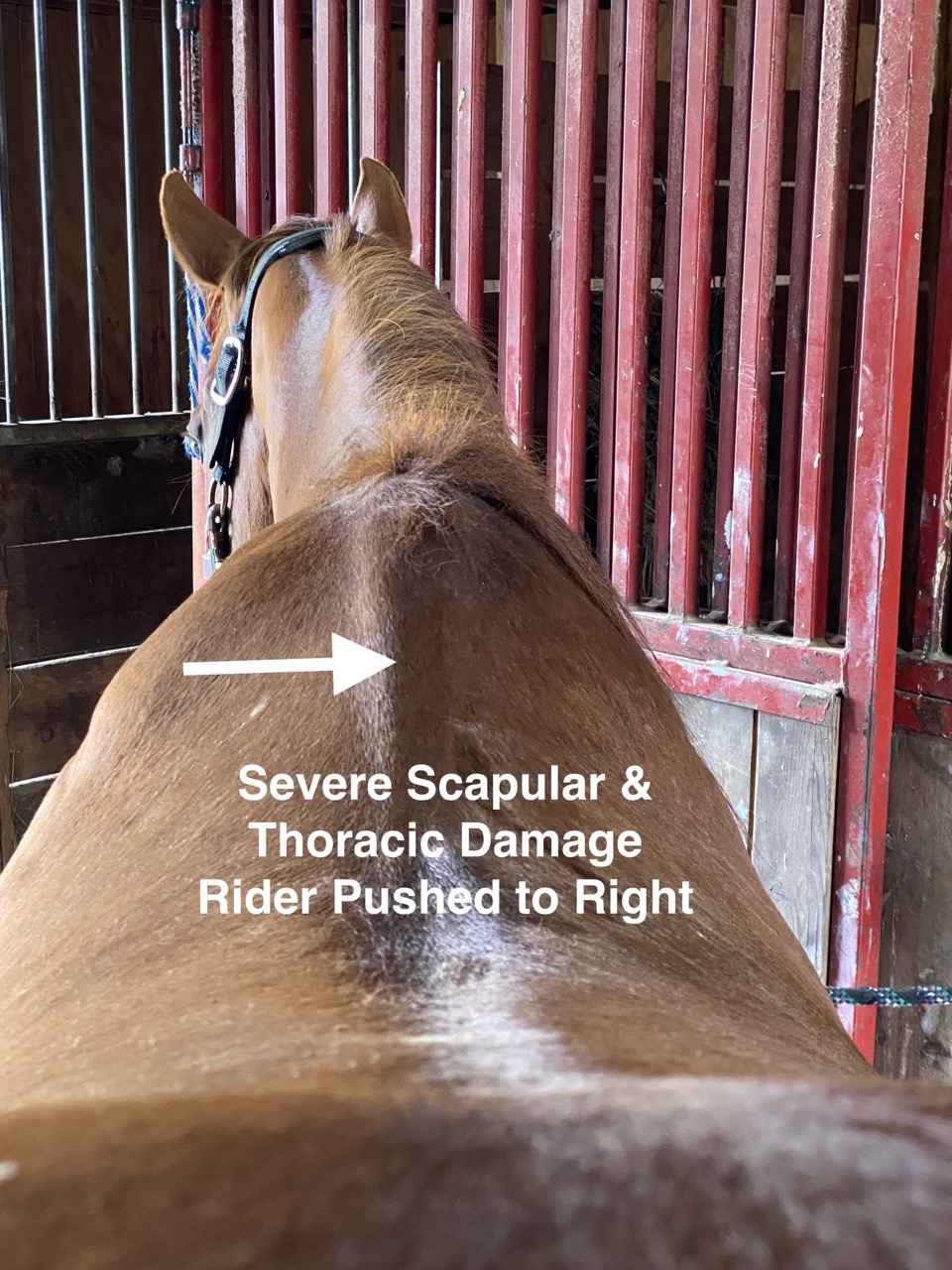
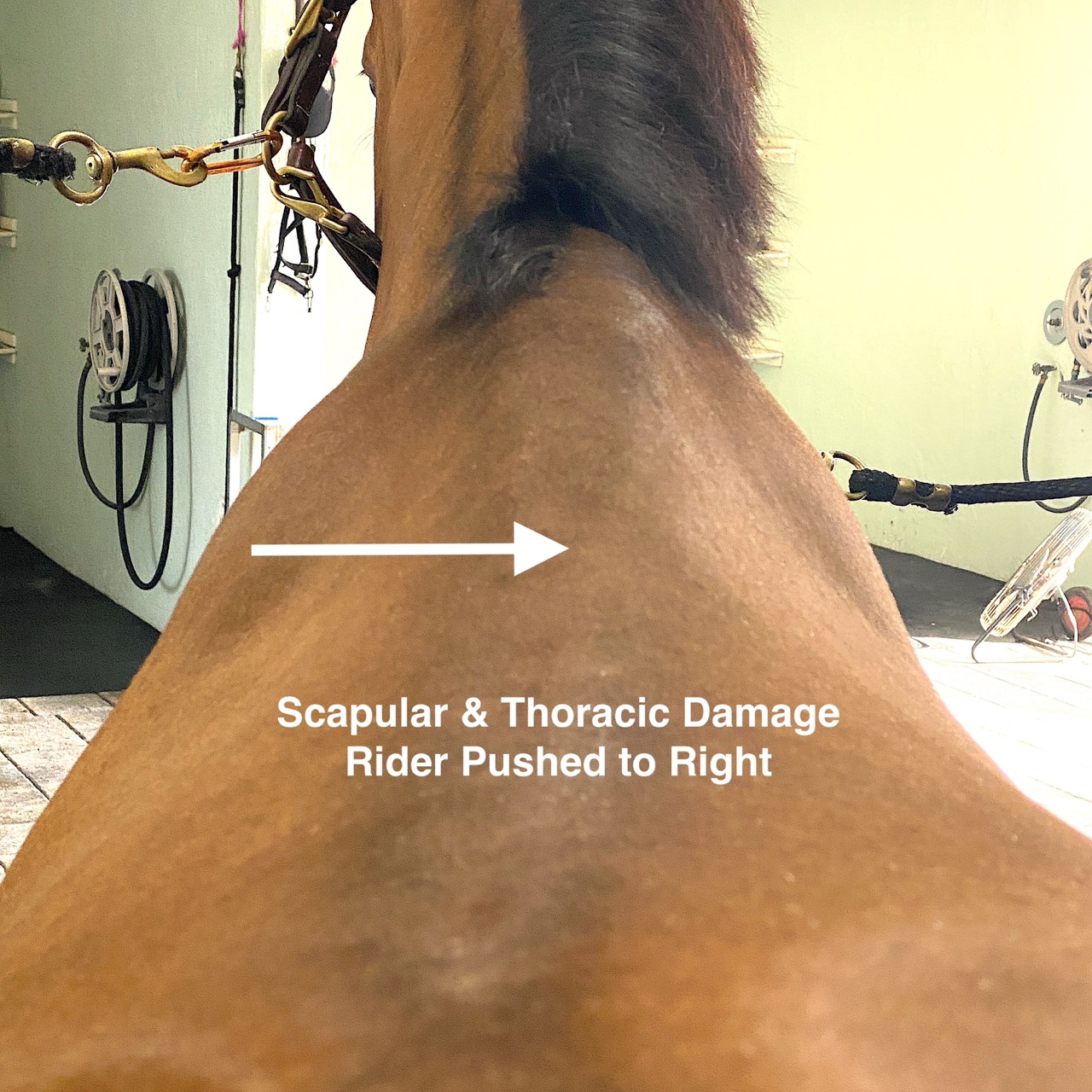
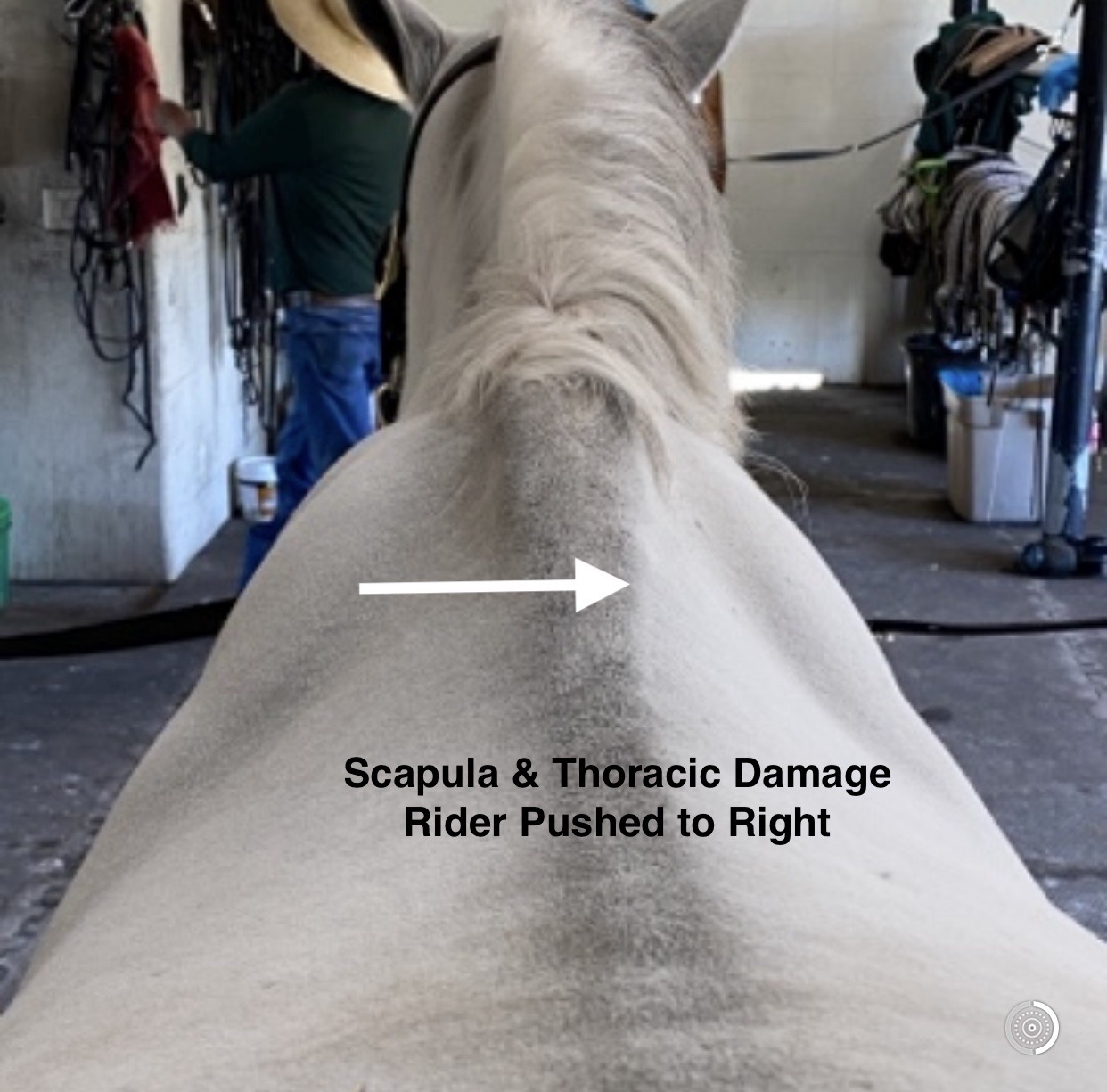
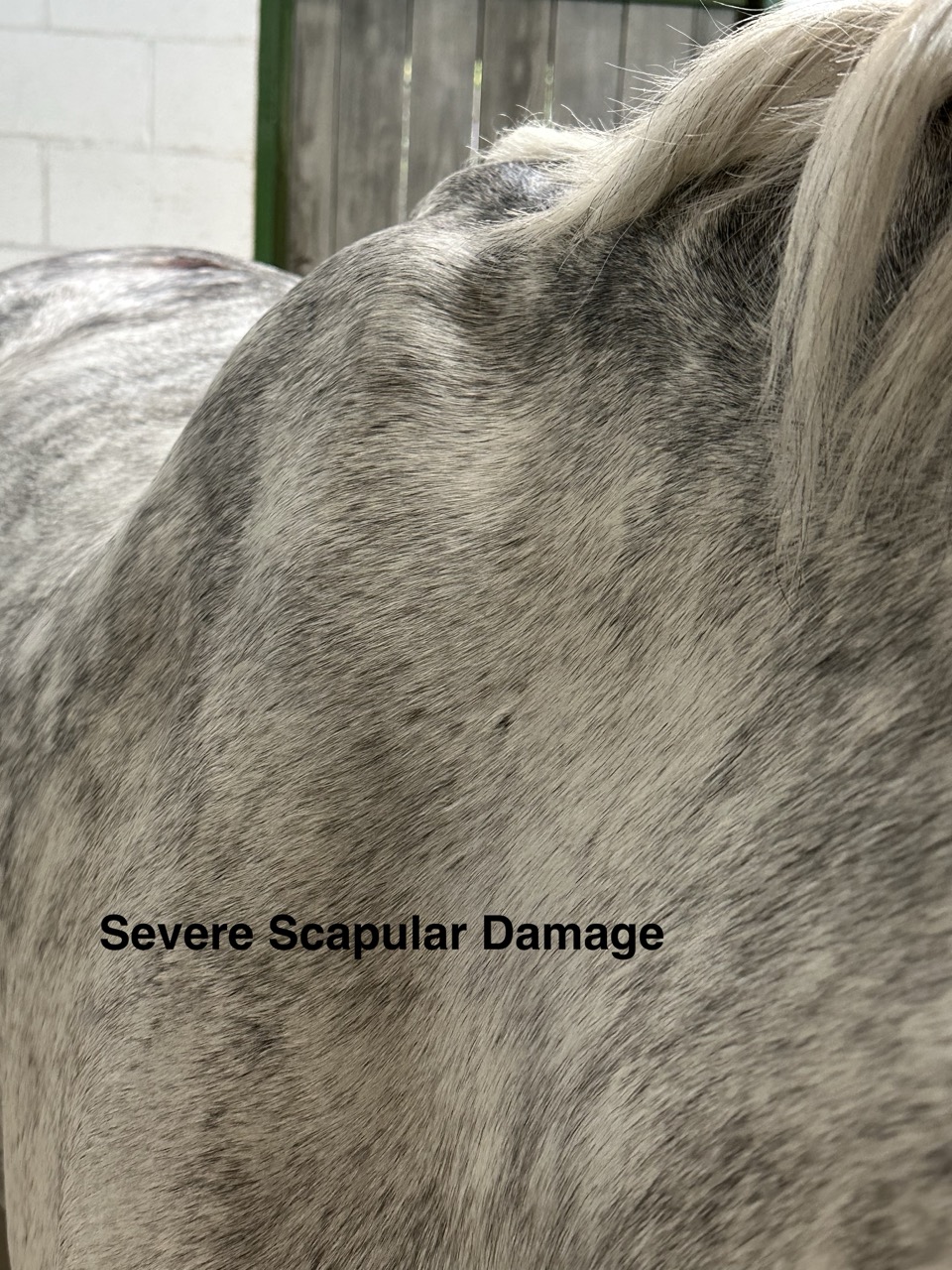
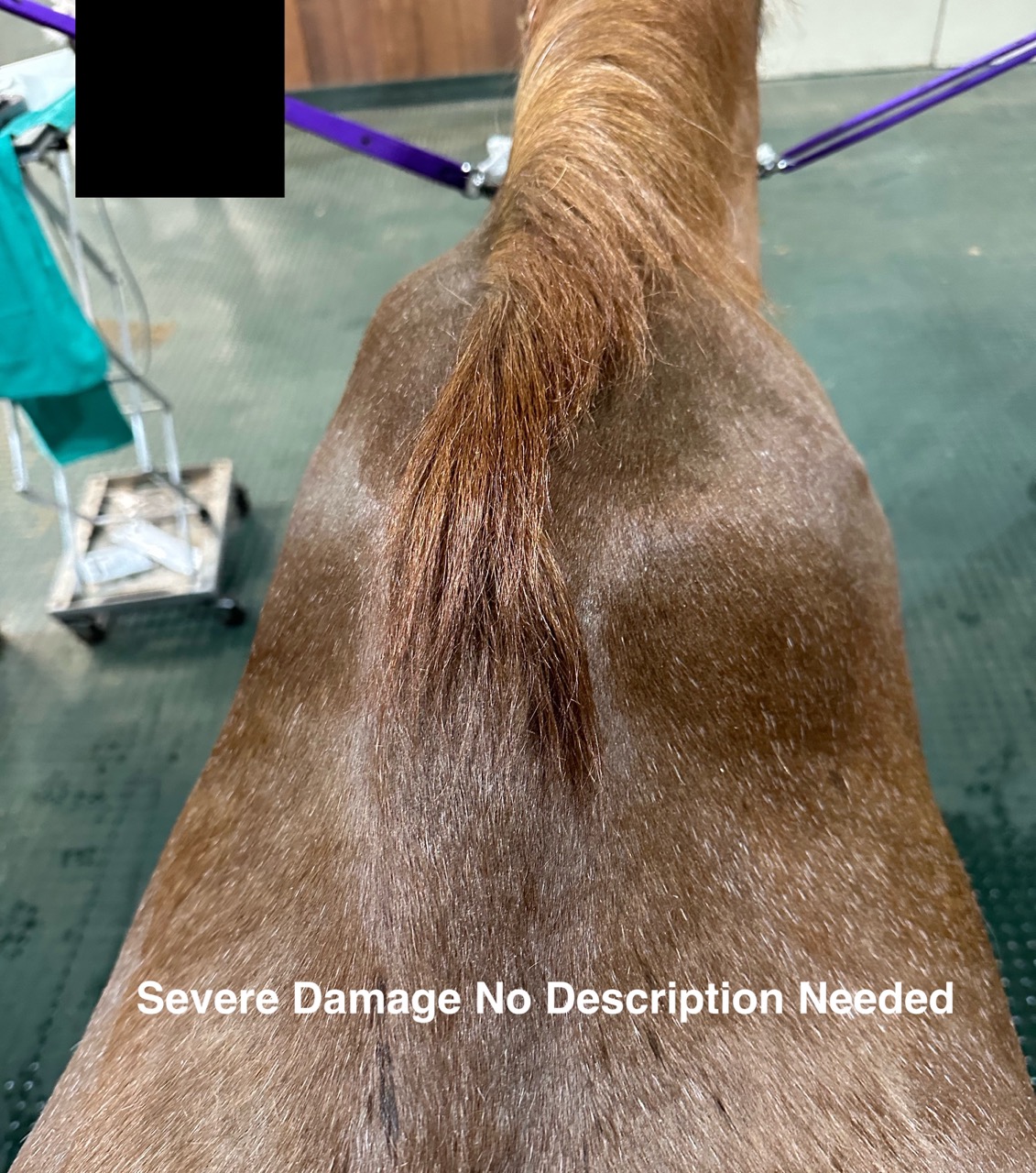
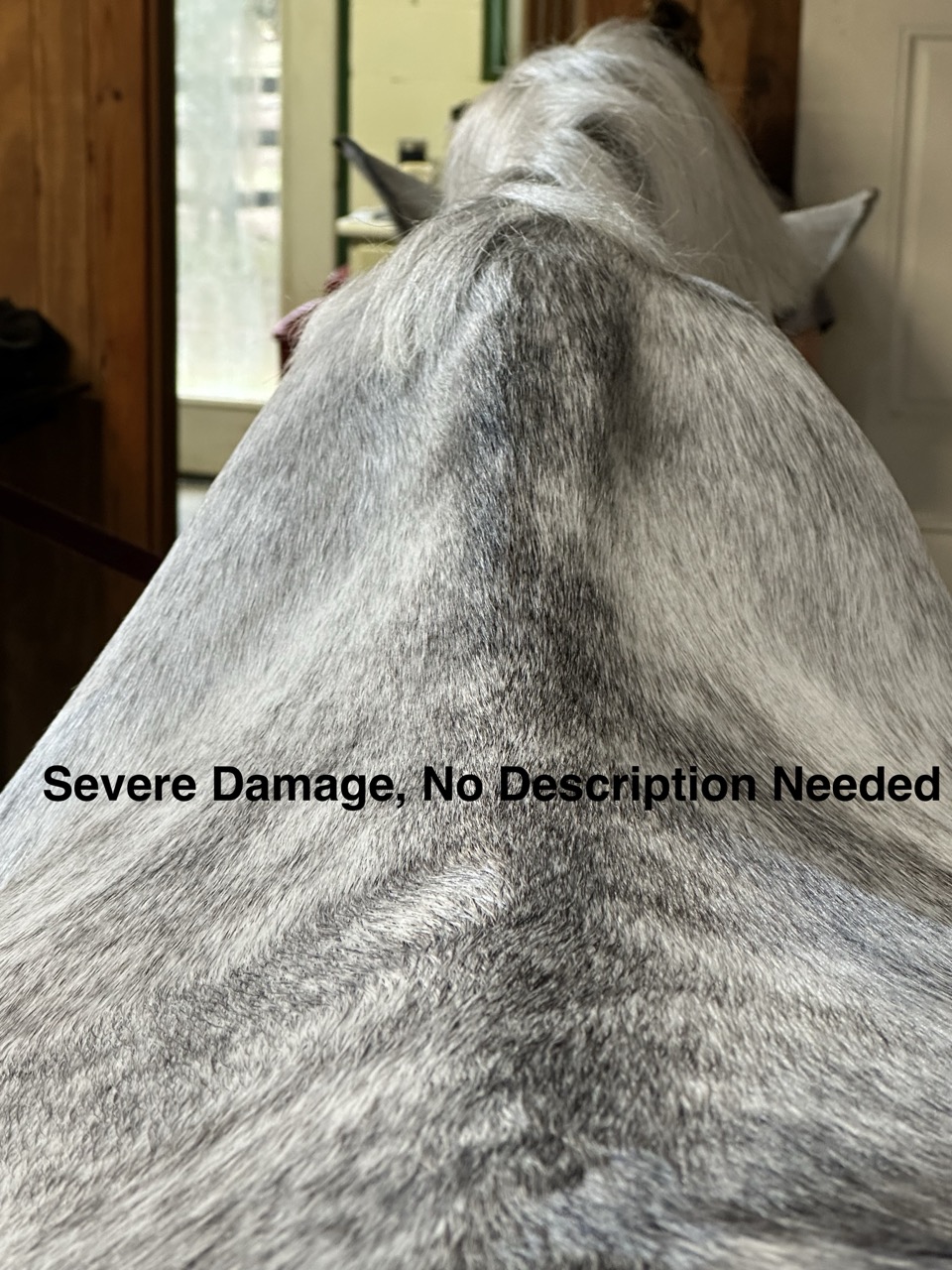
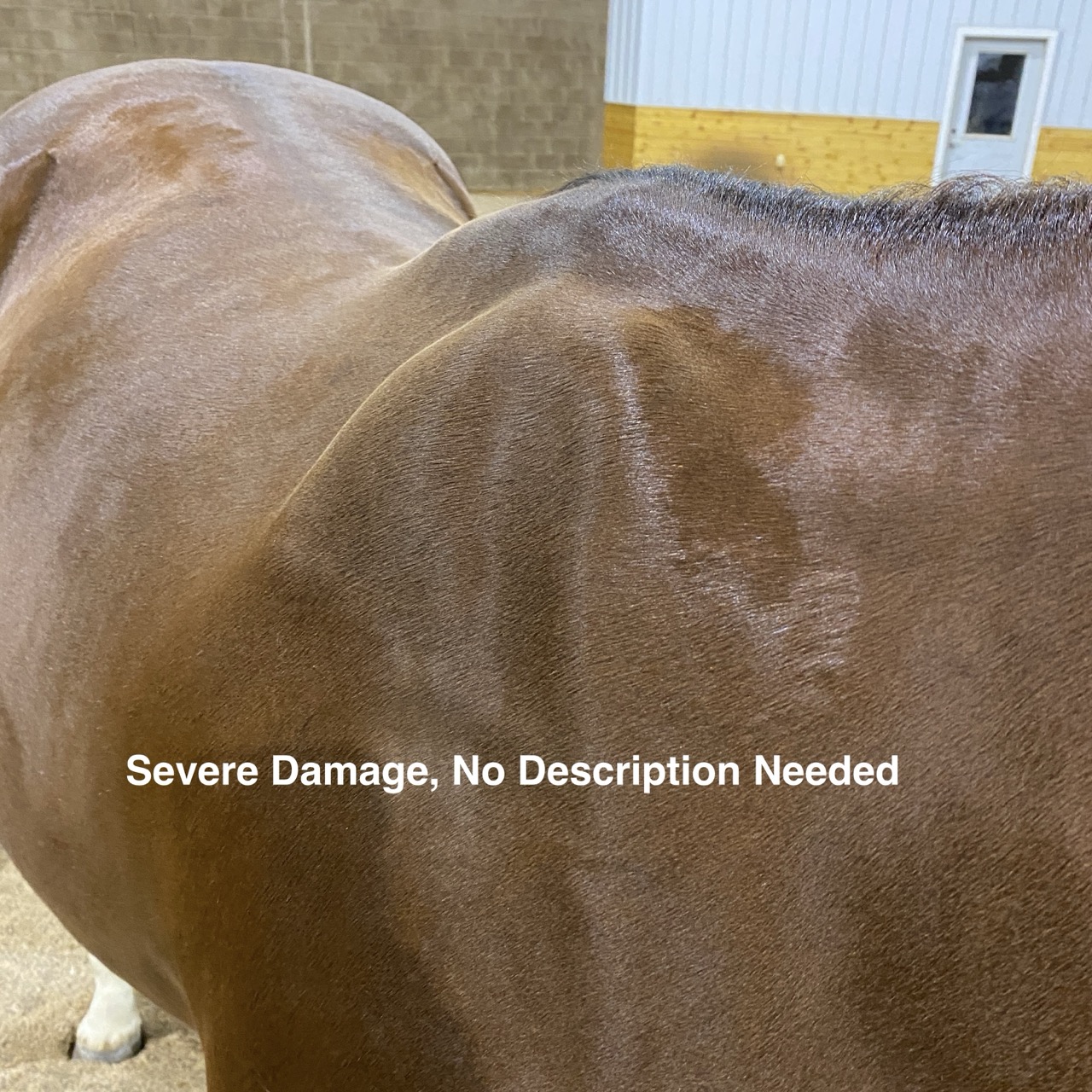
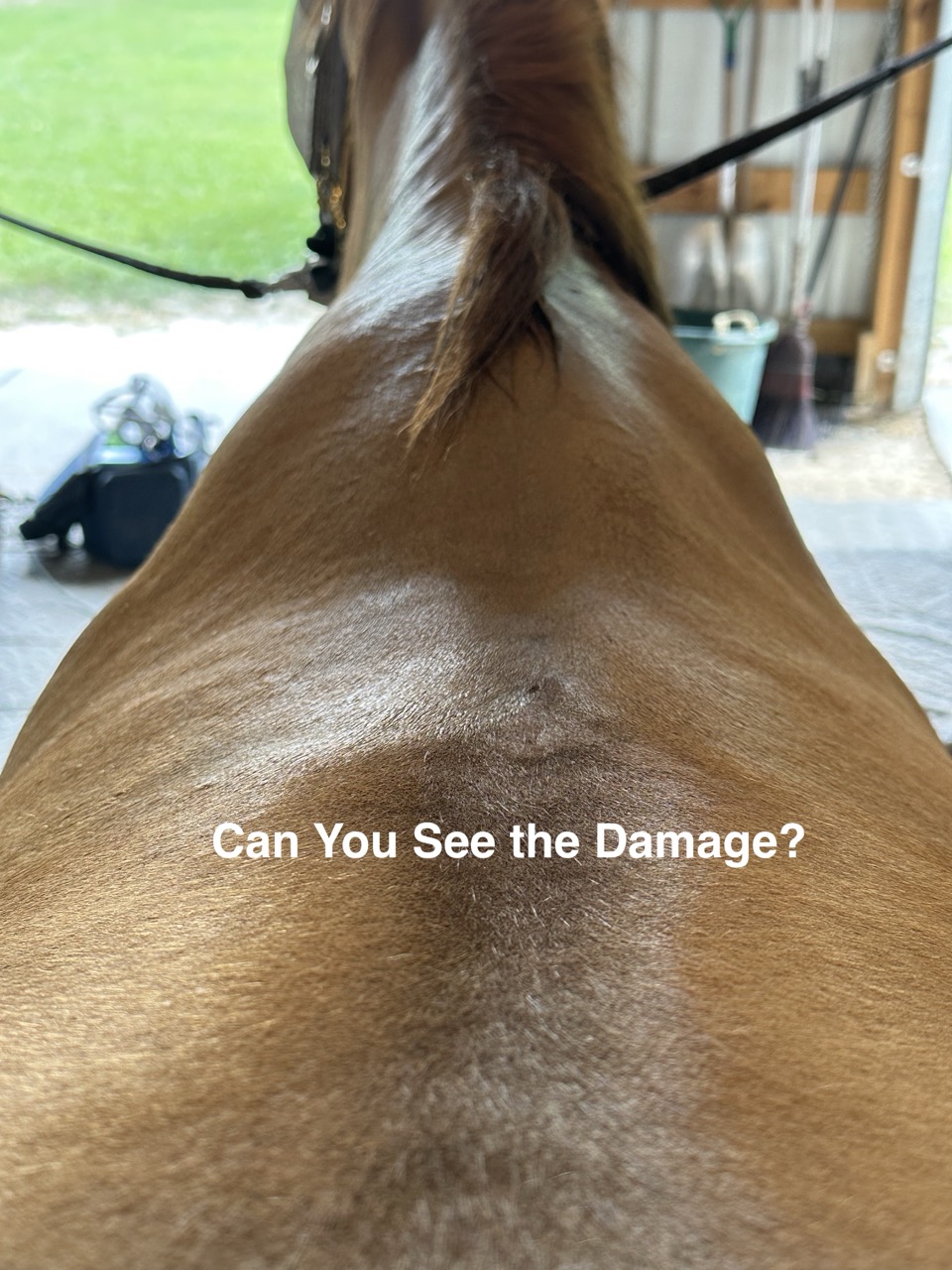
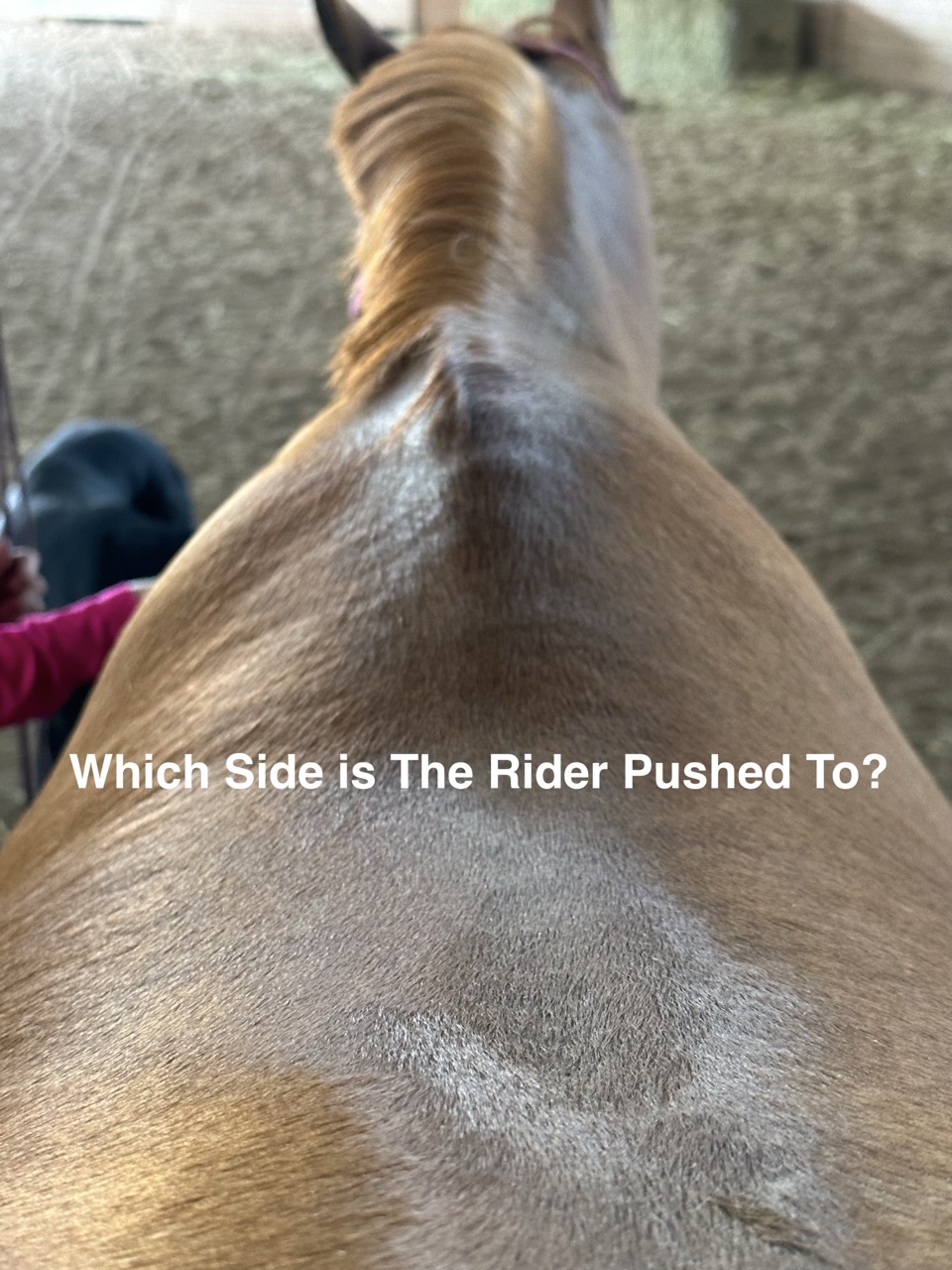
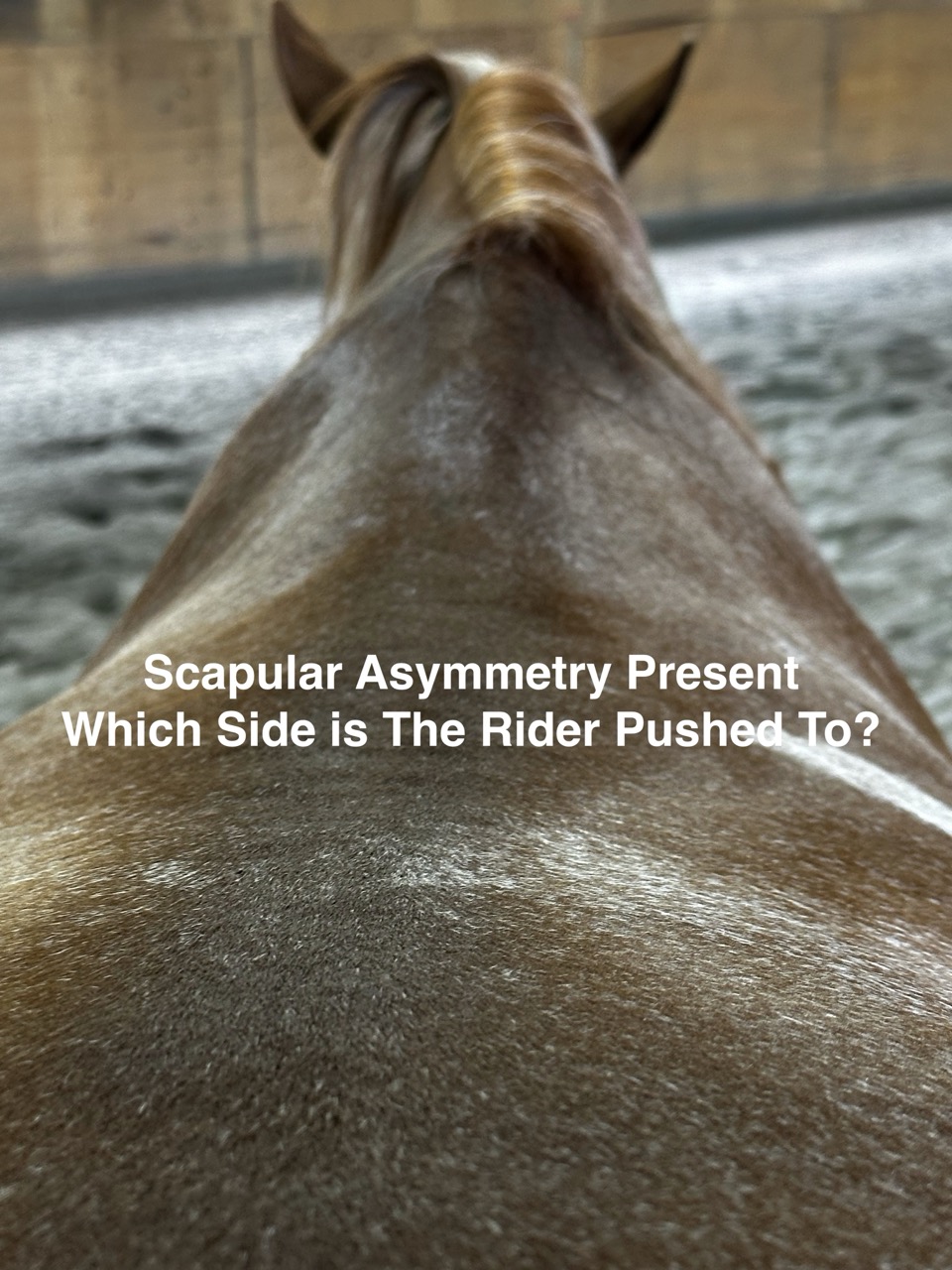
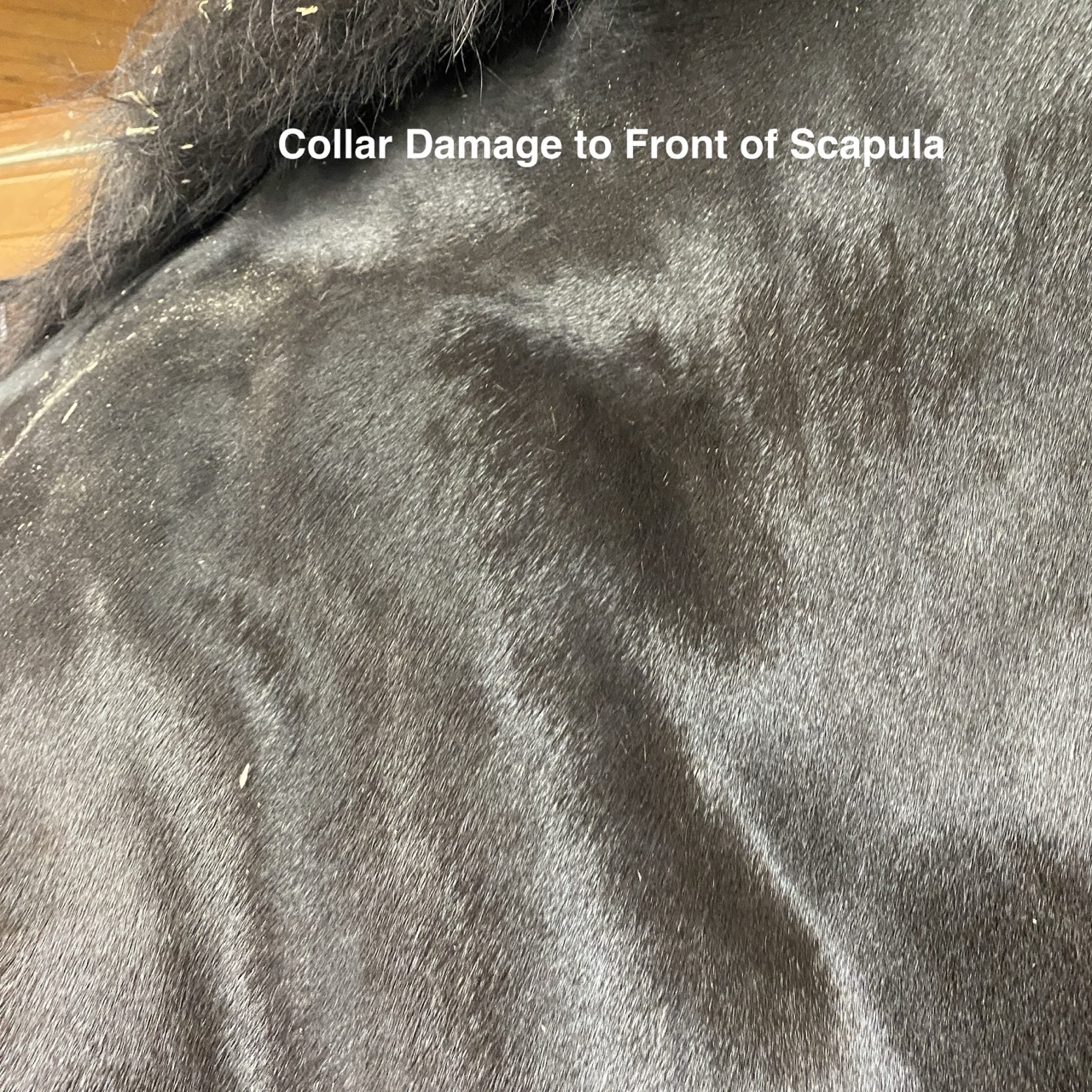
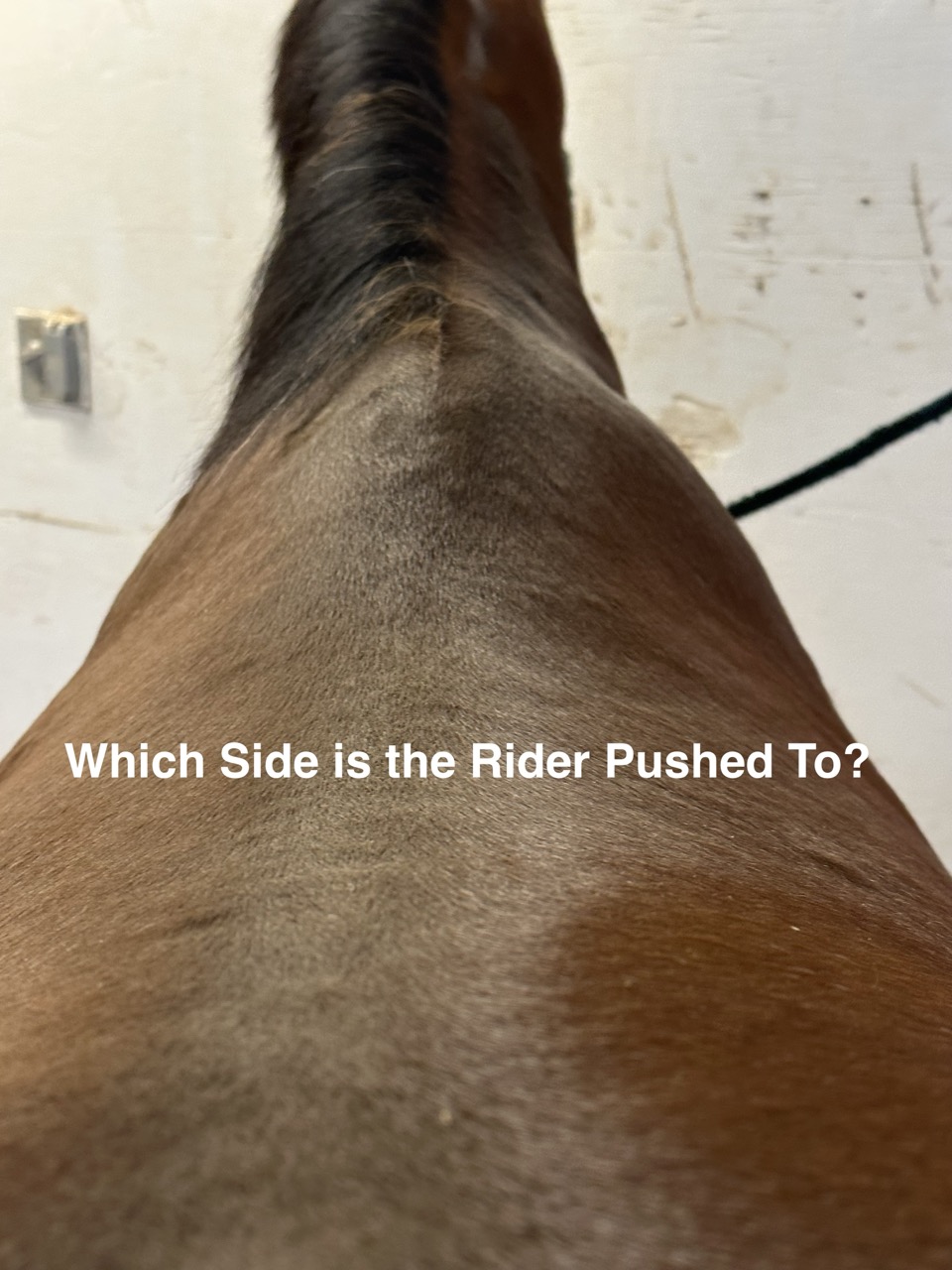
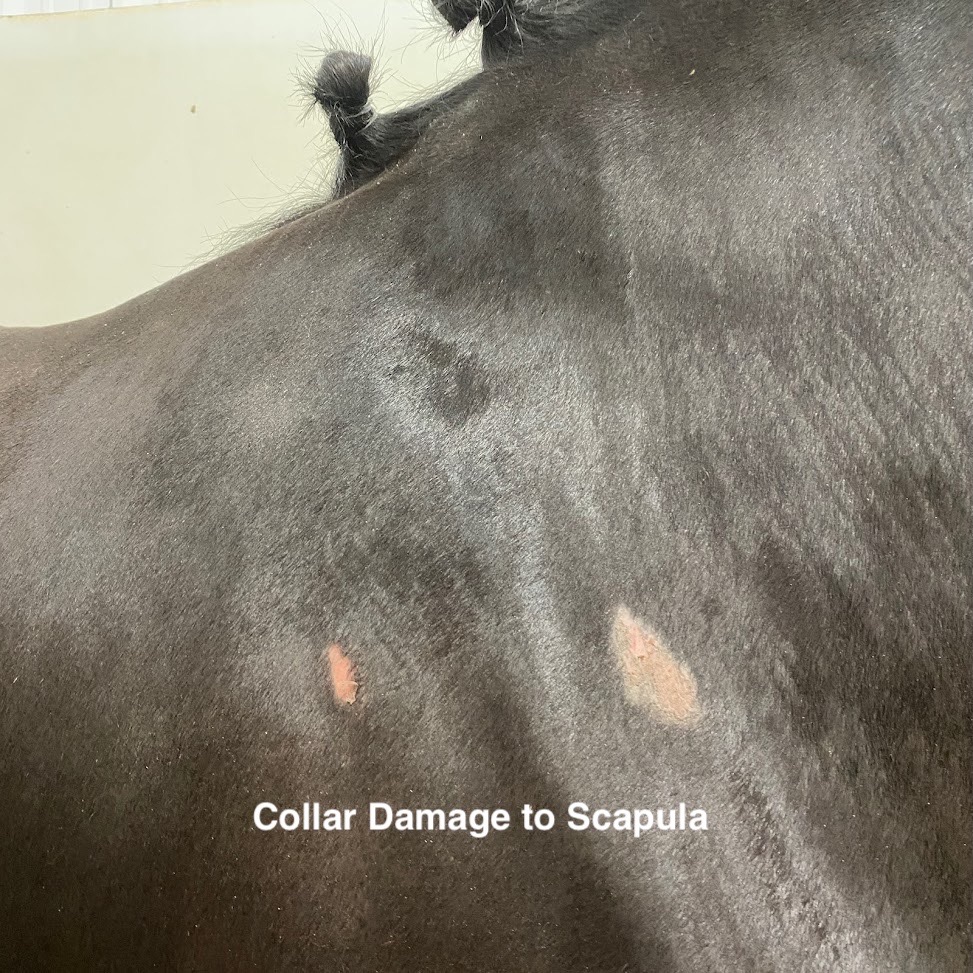
This is one of the reasons WHY horses may look great on a lunge line, but feel and look horrible under saddle.
This is one of the reasons WHY horses BULGE their shoulder, with the majority of my patient population, IT IS THE REASON WHY!
What are some other reasons? There are cervical, rib, sternum, elbow and yes, real shoulder joint reasons. They all need to be ruled out, however, I would start by simply making your horse stand square in front, and take a picture of them from behind. Simple and free. No vet bill involved. EASY PEASY.
After you have looked at all the images, the distinct pattern of the rider being pushed over from the “bulged” side with each movement of the that front limb, one cannot ignore all the surrounding structures that attach to or are interconnected to this region. One has to also take into consideration the rest of the horses body and how it will move and position itself in compensation. That is another entire semester study on equine biomechanics that will be discussed and slowly integrated into this blog.
Let’s discuss the biomechanics of all the images put together as an example for you to understand when riding a horse. I must preface this by saying, you need to envision yourself riding a horse while reading this. If a horse is bulged on the left scapula and flat on the right scapula, the rider will be pushed NO MATTER WHAT to the right with every single stride of the LEFT front limb. The rider will feel like one stirrup is longer than the other, with the right feeling longer, even though it is not. The rider will continually put more weight in the left stirrup/side of the horse which will create even MORE DAMAGE to the scapula and regional structures, thus exacerbating the trauma and damage occurring with EVERY SINGLE STRIDE of the left front. Imagine jumping the horse with this scenario? Jumping is not the problem, except for the fact that the rider is sitting off to the right (more pressure in the left side/stirrup), as it is the LANDING that creates more repetitive trauma with every single time the horse jumps. This will make the horse drift right AND the horse will hang its right front limb because the scapula is being completely “squashed”(technical word for compressed), which is WHY it is flatter. Thus, it is LANDING that we see the behavioral clinical signs of the horse throwing its neck up, swishing of the tail non-stop, bolting, rearing or refusing to jump because of the prediction of sharp pain on landing! To take this even further, the BULGED side, which is the left side in this horse example, PROHIBITS the horse from moving LEFT, thus moving in a counter-arched or “bulged” like frame, going LEFT!
SO, this is only one scenario of literally hundreds of thousands of horses that are INJURED! The pictures speak a thousand words of the kindness and how stoic horses truly are by letting us ride them even when injured, painful, and biomechanically dysfunctional.
Of course I have dwelled into the previous and new research. I found this interesting 2025 sports medicine human paper that illustrates the interrelationship between the scapula and shoulder and I loved the title:
Scapular Stabilization for Shoulder Pain: Putting the Cart Before the Horse?
Alyssa Elder1a, Christopher M. Powers1
Biokinesiology, University of Southern California
International Journal of Sports Physical Therapy
Vol. 20, Issue 2, 2025
https://doi.org/10.26603/001c.128049
There are many equine peer-reviewed papers on scapular fractures in thoroughbreds and one interesting paper in JAVMA 2024 paper with discussion on the surrounding tissues to the scapula being injured. A first of its kind so please read for enjoyment.
Return to sport activity following ultrasonographic diagnosis and conservative management of spontaneous injuries of the serratus cervicis ventralis and serratus thoracis ventralis muscles in 11 endurance horses.
Massimo Puccetti, DVM, PhD1; Nicola Pilati, DVM, PhD*; Francesca Beccati, DVM, PhD, DACVSMR, DECVSMR; Jean-Marie Denoix, DVM, PhD, DECVSMR
The answer to the question: “Why do horses bulge their shoulder” is simple to answer if the SCAPULA is considered as the PRIMARY anatomical structure completely responsible for the front limb to move! When the SCAPULA is not correctly identified or known for its biomechanical function, it will NEVER be considered as the CAUSE to the EFFECT of a “bulged” shoulder.
If you want to better understand the absolutely stupid things I do to figure out these problems, this video is an example along with hundreds of other horses I have jumped on bareback to “feel” this dysfunctional pattern. This was my cutting horse Isaiah (he has since passed). I bought him when he was 8 years old. He was extremely quirky, untrusting of humans, painful and had the two white saddle marks when I purchased him due to chronic ill-fitted saddles, plus he was very downhill and caused difficulty for me videotaping as I slide forward with every stride. The video was recorded years ago via GoPro held in my hand AND relating the stupid portion of this decision becomes evident as it was the second time that he was ever ridden bareback. The first time ridden bareback was the day before after cutting practice where he was tired though very “jiggie” when I got on. I did this to better understand on many horses to feel normal scapular movement and with Isaiah, scapular dysfunctional movement caused by years of poor saddle fit, thus the white marks. I would not advise riding any cutting horse bareback, especially quirky ones, however I am not known to have good judgement when it comes to self preservation when a problem needs to be solved, whether I am a journeyman lineman, athlete, or veterinarian.
Take a picture. Use your eyes. No special tools needed. And remember the oath. SCAPULAS exist.
Please share this blog and my podcast with your horse friends, and comment below if this was helpful. Most importantly, remember to always put The Horse First.
AJD
I’m an electrical engineer and am currently in a 6month training program to add saddle fitting to my repertoire. I take tracings mid-scapula, ~2” behind the scapula, at the base of withers, and T-18 to document the shape of a horse’s back. I also take pictures of the back (and other views) with the horses square. Your article caught my eye because every single horse I’ve looked at so far, must have scapular damage of some kind. Granted, none of them are anywhere near as severe as the ones in your photos. My tracing sheet even has a place where I can make a conformational note that the horse is either left or right “loaded” referring to which scapula has a bulge. I’ve seen this asymmetry even in horses who are very lightly or rarely ridden (like in years), and on horses who do not exhibit muscle atrophy in the thoracic trapezius (“wither pockets”).
I’d love to learn more about how to tell if the bulge is coming from scapular damage, or some of the other places you mentioned, sternum, elbow etc. and how to help the horses who I am fitting (for now in case studies but eventually clients.) I know you said more biomechanics are coming in the blog (very interested in those feet pictures!), and I can’t wait and read more then. But if you have any resources you can point me toward to get a head start I’d appreciate it.
1 Comment on Why Do Horses Bulge Their “Shoulder”?